

Itchy pregnant belly: causes, red flags, and relief
TL;DR:
- Most pregnancy-related belly itch results from skin stretching, dryness, and hormonal changes and is mostly harmless.
- Serious signs like palms and soles itching, jaundice, or dark urine require urgent medical evaluation.
Around one in four pregnant women experience itching at some point during pregnancy, so if your belly is driving you mad, you are in very good company. Start pregnancy-safe skin care now: cool water, an unperfumed emollient applied to damp skin, and loose cotton clothing will ease most cases. Contact your midwife or GP immediately if any red-flag symptoms appear alongside the itch.
Immediate steps to take right now:
- Rinse with cool or lukewarm water rather than a hot shower
- Pat skin dry gently, then apply an unperfumed emollient while still slightly damp
- Swap synthetic fabrics for loose cotton clothing next to the skin
- Keep nails short and tap or pat the skin rather than scratching
When to contact your midwife or GP urgently: Itching on the palms of your hands or soles of your feet, severe itching that wakes you at night, yellowing of the skin or eyes (jaundice), dark urine, or any rapid worsening of symptoms all require prompt medical assessment. These can be signs of intrahepatic cholestasis of pregnancy (ICP), a liver condition that needs testing. Do not wait to see if it settles on its own.
Table of Contents
- Why does your belly itch during pregnancy?
- When should you contact your midwife or GP?
- Practical self-care you can try right now
- How to choose a pregnancy-safe, plant-based product
- How to apply topical products and break the itch–scratch cycle
- Mumbubhub’s plant-based options for pregnancy belly relief
- Key takeaways
- Useful sources
- FAQ
Why does your belly itch during pregnancy?
The most likely culprits are skin stretching, moisture loss, and hormonal changes — all of which are common and, in most cases, harmless. As your bump grows, the skin across your abdomen stretches faster than it can produce new oils, leaving it dry and prone to itching. Hormonal shifts alter skin sensitivity too, which is why some women find their whole body feels more reactive during pregnancy.
That dryness triggers the itch–scratch cycle: scratching briefly relieves the sensation but damages the skin barrier, which leads to more irritation and more itching. Breaking that cycle early, with hydration and gentle application technique, is the most effective thing you can do before any medical review is needed.
Two pregnancy-specific conditions are worth knowing about:
| Condition | Typical onset | Prevalence |
|---|---|---|
| General pregnancy pruritus | Any trimester; often from around 27 weeks | ~25% of pregnancies |
| Polymorphic eruption of pregnancy (PEP/PUPPP) | Third trimester | ~1 in 160 pregnancies |
| Intrahepatic cholestasis of pregnancy (ICP) | Late second or early third trimester | ~1% of pregnancies |
PEP/PUPPP presents as intensely itchy, hive-like bumps that begin in stretch marks on the abdomen and can spread to the thighs, buttocks, and arms. It is uncomfortable but generally benign and resolves after birth.
ICP is a different matter. It is a serious liver condition that causes intense itching, often starting on the palms and soles, frequently worse at night, and usually without a visible rash. Despite affecting only around 1% of pregnancies, it carries risks that require medical monitoring throughout the remainder of pregnancy.
Key figure: Itching affects a significant minority of pregnant women, yet ICP — the condition that demands urgent attention — is comparatively uncommon. Most itching is benign, but the minority of cases that are not can have serious consequences, which is why knowing the red flags matters.
When should you contact your midwife or GP?
Contact your midwife, GP, or maternity unit without delay if you notice any of the following:
- Itching on your palms or the soles of your feet — even without a rash, this is a hallmark sign of ICP and should prompt immediate testing for bile acids and liver function
- Severe itching that disrupts your sleep — night-time intensity is a distinguishing feature of ICP
- Jaundice — yellowing of the skin or whites of the eyes
- Dark urine or pale stools — both can indicate liver involvement
- Any rapid worsening of itch, regardless of where it is on the body
For mild, localised belly itch with no red flags, a pharmacist can offer immediate advice on safe over-the-counter options and gentle, natural pampering like pregnancy henna designs to help you relax during this special time. Your midwife or GP will order blood tests — liver function and bile acid levels — if ICP is suspected. Those tests may be repeated if initial results are negative but itching continues.
NHS guidance is clear: if you have itching on your palms or soles, or if the itch is severe and persistent, contact your GP or midwife promptly. Do not rely on home measures alone when red-flag symptoms are present.
Practical self-care you can try right now
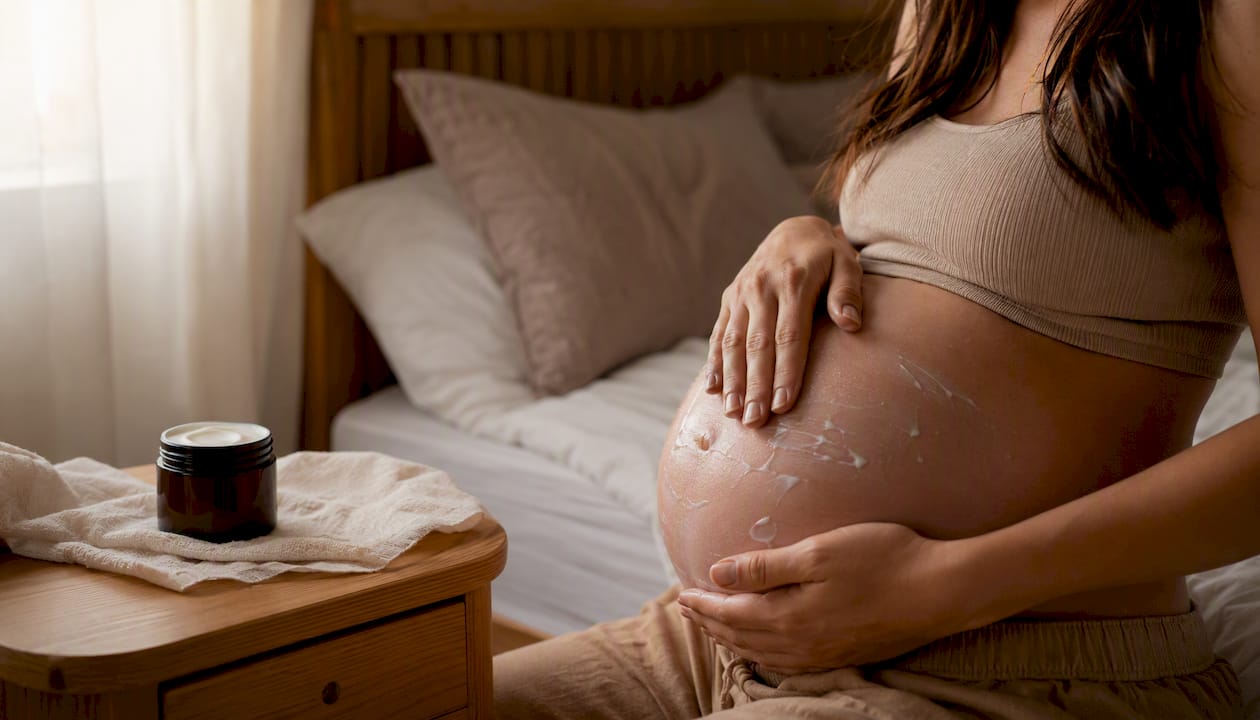
The single most effective supportive routine is: a lukewarm shower or bath, gentle pat-dry, and an unperfumed emollient applied immediately to slightly damp skin. Hot water strips the skin’s natural oils and worsens dryness; moisturising damp skin seals in moisture and reduces transepidermal water loss.
| Measure | Safe in pregnancy? | How it helps | Speed of relief |
|---|---|---|---|
| Lukewarm shower/cool bath | Yes | Reduces skin temperature; limits oil stripping | Immediate |
| Unperfumed emollient on damp skin | Yes | Locks in moisture; restores skin barrier | Within hours |
| Loose cotton clothing | Yes | Reduces friction and heat against skin | Immediate |
| Pregnancy bath soak (oat-based, unperfumed) | Yes, with care | Soothes inflammation; calms the itch–scratch cycle | Within one session |
| Antihistamines (pharmacist/GP advised) | Some, under guidance | Reduces histamine-driven itch; may aid sleep | Hours; consult first |
| Topical steroids (clinician-prescribed) | Under supervision only | Reduces inflammation in PEP/PUPPP | Days; clinician-led |
NHS guidance is explicit that these supportive measures are helpful but do not replace medical evaluation when red flags are present. If a pharmacist recommends an antihistamine, confirm it is approved for pregnancy before taking it.
Pro Tip: Apply your emollient or bump oil about 20 minutes before bed, then wear a soft cotton sleep top. The combination of sealed-in moisture and a non-abrasive fabric significantly reduces the urge to scratch during the night, when ICP-related itch tends to peak.
How to choose a pregnancy-safe, plant-based product
The safest plant-based topical for an itchy belly is fragrance-free, has a short and recognisable ingredient list, and uses an emollient base that is well-tolerated in pregnancy. That is the whole checklist in one sentence. Everything else is detail.
Ingredients that are generally considered safe and soothing:
- Emollient plant oils rich in linoleic acid (such as rosehip, sweet almond, or sunflower seed oil) — these support the skin barrier without clogging pores
- Colloidal oatmeal — clinically recognised for calming itch and reducing inflammation
- Shea butter and cocoa butter — occlusive emollients that lock in hydration
- Calendula extract — gentle botanical with a long history of use on sensitive skin
Ingredients to approach with caution or avoid:
- Strong essential oil blends (particularly clary sage, rosemary, and tea tree in high concentrations) — some carry systemic-safety questions in pregnancy; always check with your midwife
- Retinoids (vitamin A derivatives) — not recommended during pregnancy
- Synthetic fragrance — a common irritant that can worsen itch and trigger sensitisation
When reading labels, look for terms such as unperfumed, dermatologically tested, and suitable for use in pregnancy. Those claims are a useful starting point, but they are not a substitute for reading the actual ingredient list. A product with five recognisable botanical ingredients is generally a safer bet than one with thirty, regardless of what the front of the packaging says.
For a broader look at building a safe routine, Mumbubhub’s guide to a natural pregnancy skincare routine covers ingredient choices in more depth. Always patch-test a new product on a small area of skin before applying it to your bump, and check with your midwife if you have any doubts about a specific ingredient.
How to apply topical products and break the itch–scratch cycle
The most effective single routine: lukewarm bath or shower, pat skin dry leaving it slightly damp, apply your chosen unperfumed emollient or plant oil, and repeat twice daily.
- Shower or bathe in lukewarm water — keep it under five minutes if possible; longer exposure removes more skin oil
- Pat dry with a soft towel — do not rub; leave the skin slightly damp
- Apply emollient or oil immediately — use enough to cover the full bump area; work it in with gentle circular strokes rather than vigorous rubbing
- Layer products if needed — apply a lighter oil first (such as Mumbubhub’s bump and body oil), then seal with a thicker balm on particularly dry patches
- Repeat morning and evening — consistency matters more than quantity per application
To reduce scratching between applications: keep nails trimmed short, use tapping or patting instead of scratching when the urge strikes, and press a cool damp cloth against the skin for 30 seconds. The itch–scratch cycle worsens inflammation each time skin is broken, so even small behavioural changes add up.
If a product causes increased redness, stinging, or a new rash, stop using it and speak to your midwife or pharmacist before trying another.
Pro Tip: For stretch-related itch specifically, applying your bump oil immediately after your evening shower and then wearing a soft cotton sleep top creates a gentle occlusive layer overnight. Skin that stays hydrated through the night tends to itch far less by morning. More on managing stretch-related skin changes is covered in Mumbubhub’s guide to stretch mark care during pregnancy.
Mumbubhub’s plant-based options for pregnancy belly relief
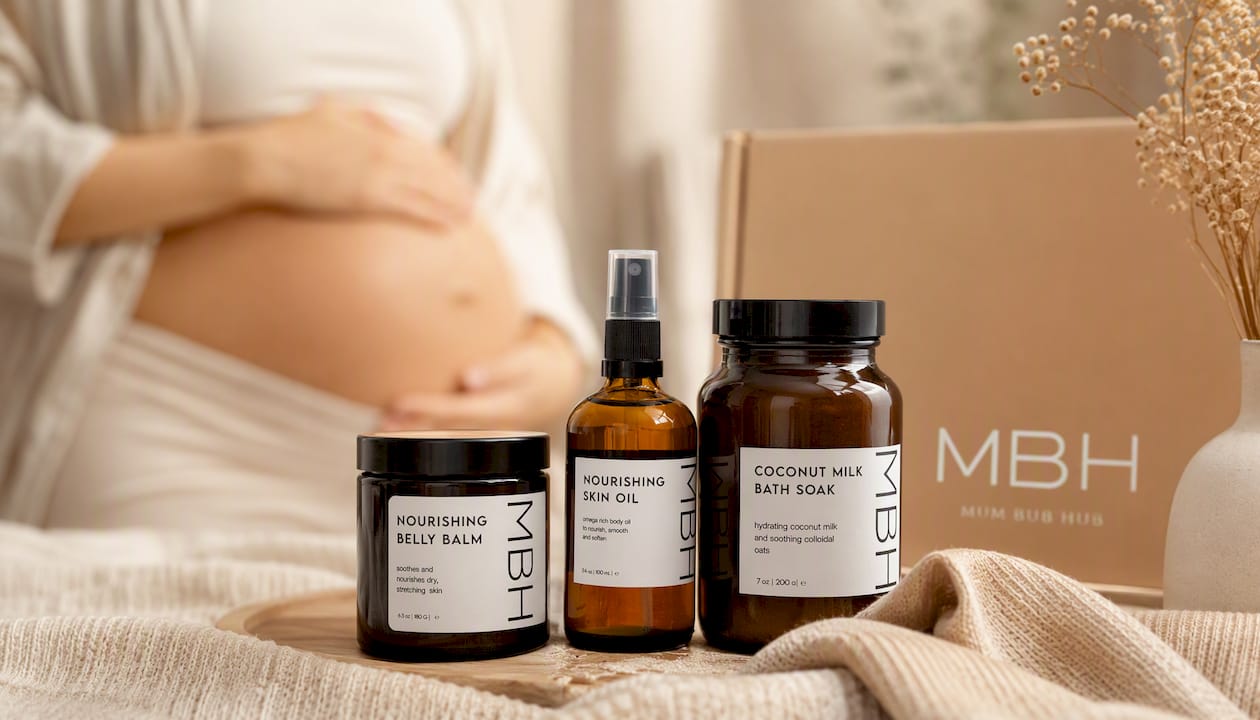
Mumbubhub formulates its pregnancy products with plant-based, chemical-free ingredients and makes them available across the UK. All three products below are designed with the safety and sensitivity of pregnancy skin in mind.
Pregnancy Belly Balm
The Pregnancy Belly Balm is Mumbubhub’s daily-use option for dry, itchy bump skin. It uses a short list of botanical emollients to restore the skin barrier and reduce the dryness that drives the itch–scratch cycle. Apply it twice daily after showering, while skin is still slightly damp, for best results. It is particularly well-suited to women whose itch is driven by skin stretching and dryness rather than a specific dermatosis.
Pregnancy Pamper Bundle
For those who want a complete self-care kit rather than a single product, the Pregnancy Pamper Bundle brings together Mumbubhub’s pregnancy essentials in one purchase. It makes a practical gift for expectant mothers and covers more than just belly itch, supporting overall skin comfort through the later trimesters. If you are buying for yourself and want to address multiple pregnancy skin concerns at once, the bundle offers better value than individual products.
Nourishing Body Oil
The Nourishing Body Oil is a lighter-texture option that absorbs quickly and works well as the first layer in a two-step routine (oil, then balm on dry patches). It is particularly useful for evening application, when locking in moisture before bed can reduce night-time itching. The plant oil base supports the skin barrier without synthetic fragrance or harsh additives.
Mumbubhub lists full ingredient information on each product page, so you can check every ingredient against your midwife’s guidance before purchasing. If you are unsure which product suits your situation, start with the Belly Balm for targeted daily use, or the bundle if you want broader pregnancy skin support. Browse the full range and place your order at mumbubhub.co.uk.
Key takeaways
Most itchy pregnant belly cases are caused by skin stretching and dryness, respond well to unperfumed emollients and cool water, and resolve after birth — but palms/soles itching or severe night-time itch always needs urgent medical assessment.
| Point | Details |
|---|---|
| How common it is | Around 25% of pregnant women experience itching; most cases are benign. |
| Red flags to act on | Palms/soles itch, severe night-time itch, jaundice, or dark urine — contact your midwife or GP immediately. |
| Most effective self-care | Lukewarm shower, unperfumed emollient on damp skin, loose cotton clothing — applied consistently twice daily. |
| What to look for in products | Fragrance-free, short botanical ingredient list; avoid retinoids and strong essential oil blends. |
| Mumbubhub recommendation | The Pregnancy Belly Balm and Nourishing Body Oil offer plant-based, UK-available daily relief for stretch-related itch. |
A note from us at Mumbubhub
Pregnancy itch is one of those things that sounds minor until it is keeping you awake at 3 AM. The reassuring truth is that for the vast majority of women, it is temporary and very manageable with the right routine and the right products. At Mumbubhub, every pregnancy product we formulate starts from the same question: would we be comfortable recommending this to someone in their third trimester? Our plant-based, fragrance-free formulations are built around that standard, and we back them with full ingredient transparency so you can make an informed choice alongside your midwife’s guidance. You deserve support that is both safe and genuinely soothing — and that is exactly what we set out to provide.
Useful sources
These are the sources to consult for clinical guidance, testing information, and further reading. Show them to your midwife or GP if you want to discuss testing or treatment options.
- NHS: Itching in pregnancy and ICP — the primary UK clinical reference for symptoms, red flags, and when to seek help
- RCOG / NCT: Itchy skin in pregnancy and ICP — covers ICP symptoms, diagnosis, and monitoring in detail, citing RCOG 2022 guidance
- StatPearls / NCBI: Pruritus in pregnancy — clinical overview of all pregnancy-related itch conditions, including ICP onset timing and bile acid testing
- PMC: Polymorphic eruption of pregnancy (PUPPP) — peer-reviewed article on PEP/PUPPP prevalence, presentation, and management
- Cleveland Clinic: PUPPP rash — accessible patient-facing explanation of PUPPP symptoms, timeline, and treatment options
- Cambridge University Hospitals NHS: ICP — NHS Trust patient information on ICP, including the one-in-four itching statistic
- BHR Hospitals NHS: Obstetric cholestasis — NHS Trust guidance on supportive care measures and when to escalate
FAQ
Is it normal for your belly to itch during pregnancy?
Yes. Around 25% of pregnant women experience itching, most commonly caused by skin stretching and dryness as the bump grows. It is usually harmless, but always mention it to your midwife.
What helps relieve an itchy pregnant belly at home?
Apply an unperfumed emollient to slightly damp skin immediately after a lukewarm shower, wear loose cotton clothing, and avoid hot water. Consistency twice daily makes the biggest difference.
When is itching in pregnancy a sign of something serious?
Contact your midwife or GP promptly if itching affects your palms or soles, is severe at night, or is accompanied by jaundice or dark urine. These can indicate ICP, a liver condition that requires blood tests and monitoring.
How long does pregnancy belly itch usually last?
General pregnancy itch often begins around 27 weeks and typically resolves within a few weeks of birth. PEP/PUPPP usually clears within days to weeks postpartum; ICP resolves once the pregnancy ends.
Are plant-based belly balms safe to use during pregnancy?
Fragrance-free, plant-based balms with short, recognisable ingredient lists are generally well-tolerated in pregnancy. Avoid products containing retinoids or strong essential oil blends, and check with your midwife if you are unsure about a specific ingredient.