

Types of natural pregnancy moisturisers: what to choose
TL;DR:
- Most pregnant women can safely use fragrance-free natural moisturizers that support the skin barrier, avoiding retinoids and high-dose salicylic acid. Choosing the right type depends on skin needs, with options including lotions, butters, oils, and balms, each suited for different areas and dryness levels. Verifying ingredients through third-party certifications and careful label scanning is essential for safe, effective pregnancy skincare.
Most pregnant women can safely use natural lotions, body butters, oils, and balms throughout pregnancy. The single most important rule: avoid retinoids (including retinyl palmitate) and high-dose salicylic acid. Beyond that, fragrance-free, barrier-supportive formulas are your safest starting point.
The main types of natural pregnancy moisturisers at a glance:
-
Lotions and creams — lightweight, fast-absorbing, good for everyday face and body use
-
Body butters and balms — richer, more occlusive, ideal for the bump, breasts, and very dry patches
-
Body oils — emollient and versatile; jojoba, rosehip, and avocado are widely used for bump care
-
Stretch-mark creams — targeted formulas combining humectants and emollients; check labels carefully for retinyls
Table of Contents
- 1. What are the main types of natural pregnancy moisturisers?
- 2. Which ingredients should you avoid during pregnancy?
- 3. Which natural ingredients are genuinely safe and useful?
- 4. What do ‘natural’ and ‘organic’ labels actually mean in the UK?
- 5. How do you choose a pregnancy-safe natural moisturiser?
- 6. How and where should you apply moisturiser during pregnancy?
- 7. Common myths about natural pregnancy skincare
- 8. How are pregnancy skincare products regulated in the UK?
- 9. How to source and verify genuinely natural moisturisers in the UK
- Key takeaways
- The case for keeping it simple
- Mumbubhub’s pregnancy-safe natural products
- Useful sources
- FAQ
1. What are the main types of natural pregnancy moisturisers?
Understanding the difference between product types helps you match texture to skin need and body area. Here is a practical breakdown.
Lotions and creams are water-based with a lighter feel. They absorb quickly, which makes them practical for daily face and body use, especially if your skin leans oily or you live somewhere warm. The trade-off is that they offer less occlusion than a butter or balm, so very dry or itchy skin may need something richer.
Body butters are dense, oil-heavy formulas that sit on the skin longer and seal in moisture more effectively. Shea and cocoa butter are the most common bases. They work particularly well on the bump and thighs where skin is stretching fastest. Whipped body butters in a whipped texture are easier to spread than solid block butters and absorb without leaving a heavy residue.
Body oils are pure emollients with no water phase. Jojoba, rosehip, and avocado oil are widely used for bump care and are positioned as supportive for skin suppleness. Oils layer beautifully over a water-based serum or mist, and lighter versions like jojoba or squalane work well on the face without clogging pores.
Balms are the most occlusive option. They typically combine plant butters with waxes (beeswax or candelilla wax) and are best used on specific areas: the bump, nipples, or perineum. Because they contain very little water, they tend to have shorter ingredient lists, which makes them easier to verify for reactive skin.
Stretch-mark creams sit somewhere between a lotion and a butter. They often combine humectants like hyaluronic acid or glycerin with emollients and sometimes actives. Consistent moisturising supports comfort and may ease the itch of stretching skin, but no cream reliably prevents stretch marks. Check the label carefully — some firming variants include retinyl palmitate.
| Type | Texture | Best for | Absorption | Pregnancy note |
|---|---|---|---|---|
| Lotion/cream | Light, fluid | Face, daily body | Fast | Good for oily or combination skin |
| Body butter | Dense, rich | Bump, thighs, breasts | Slow | Excellent for very dry or itchy areas |
| Body oil | Silky, non-foaming | Bump, massage | Medium | Layer over damp skin for best effect |
| Balm | Thick, waxy | Bump, nipples, perineum | Slow | Short ingredient lists; easy to verify |
| Stretch-mark cream | Medium | Bump, hips | Medium | Scan for retinyl palmitate before buying |
Pro Tip: Layer by function for the best result. Apply a humectant first (hyaluronic acid, glycerin, or aloe vera gel) to damp skin, follow with an emollient oil, then seal with a butter or balm on the driest areas. Use lighter oils on your face and richer butters on the bump.
2. Which ingredients should you avoid during pregnancy?
A short avoidance list is more useful than a long one. Focus on these categories when scanning labels.
- Retinoids, retinol, and retinyl palmitate — UK guidance flags retinoids as ingredients to avoid in pregnancy. Topical body products carry lower systemic risk than oral retinoids, but retinyl palmitate in firming creams is still worth avoiding as a precaution.
- High-dose salicylic acid — spot treatments and chemical peels with high concentrations are unsuitable. Low-percentage salicylic acid in a rinse-off product is generally considered lower risk, but high-strength leave-on formulas are best avoided.
- Concentrated essential oil blends — practitioners caution that many essential oils are potent; pregnant women are advised to avoid therapeutic-strength blends and prefer fragrance-free preparations.
- Caffeine-heavy firming actives — anti-cellulite products often combine caffeine with retinyls and strong actives. The combination is unnecessary and the retinyl risk alone is reason enough to skip them.
- Synthetic fragrance — not a safety emergency in trace amounts, but fragrance is a common sensitiser, and pregnancy skin is already more reactive. Fragrance-free is the lower-risk default.
3. Which natural ingredients are genuinely safe and useful?
Pregnancy is not the time for an aggressive skincare routine. The goal shifts to comfort, hydration, and barrier support. These ingredients deliver on all three.
Humectants draw water into the skin. Hyaluronic acid, glycerin, and aloe vera are all well-tolerated and effective. Hyaluronic acid, niacinamide, and shea butter are among the most commonly recommended pregnancy moisturiser ingredients by skincare guides and practitioners.
Emollients soften and smooth. Jojoba oil closely mimics the skin’s own sebum, making it one of the most versatile options for both face and body. Squalane (plant-derived) is similarly lightweight and non-comedogenic. Rosehip and avocado oil are richer and better suited to the bump and thighs.
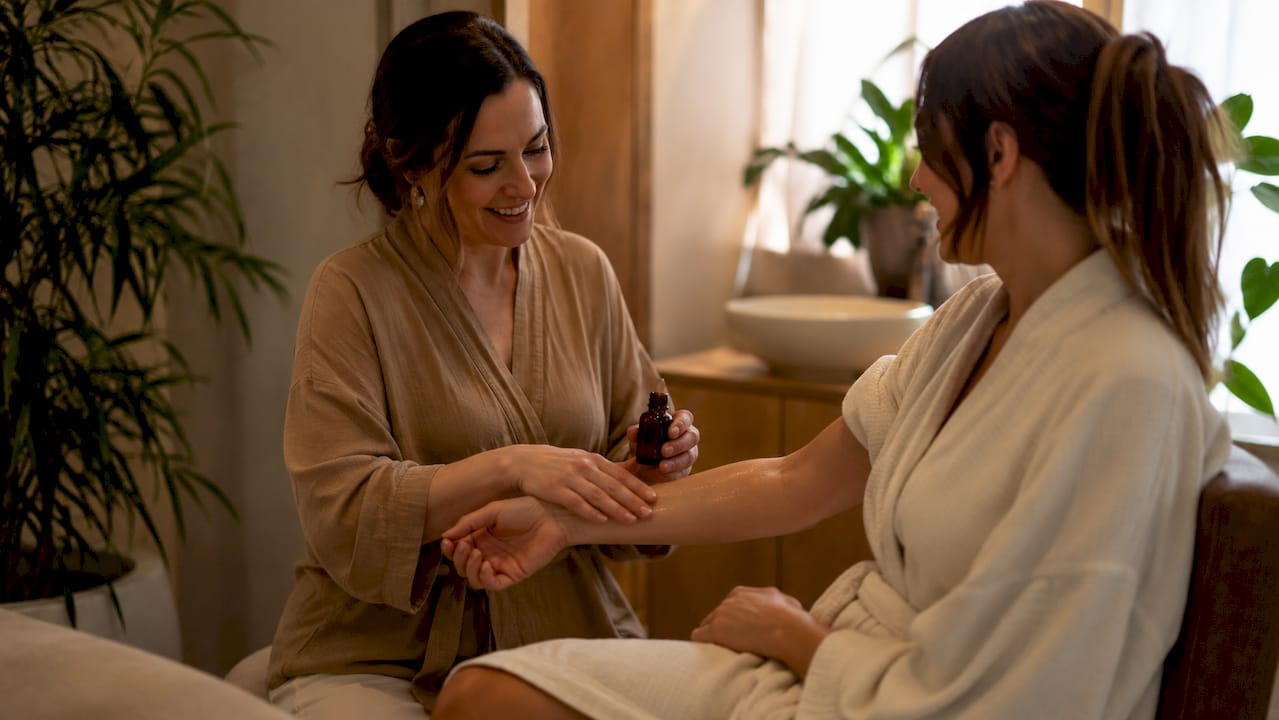
Occlusives seal moisture in. Shea butter and cocoa butter are the most widely used natural occlusives in pregnancy products. Both are generally considered safe for use on large body areas. Beeswax and candelilla wax serve the same function in balms.
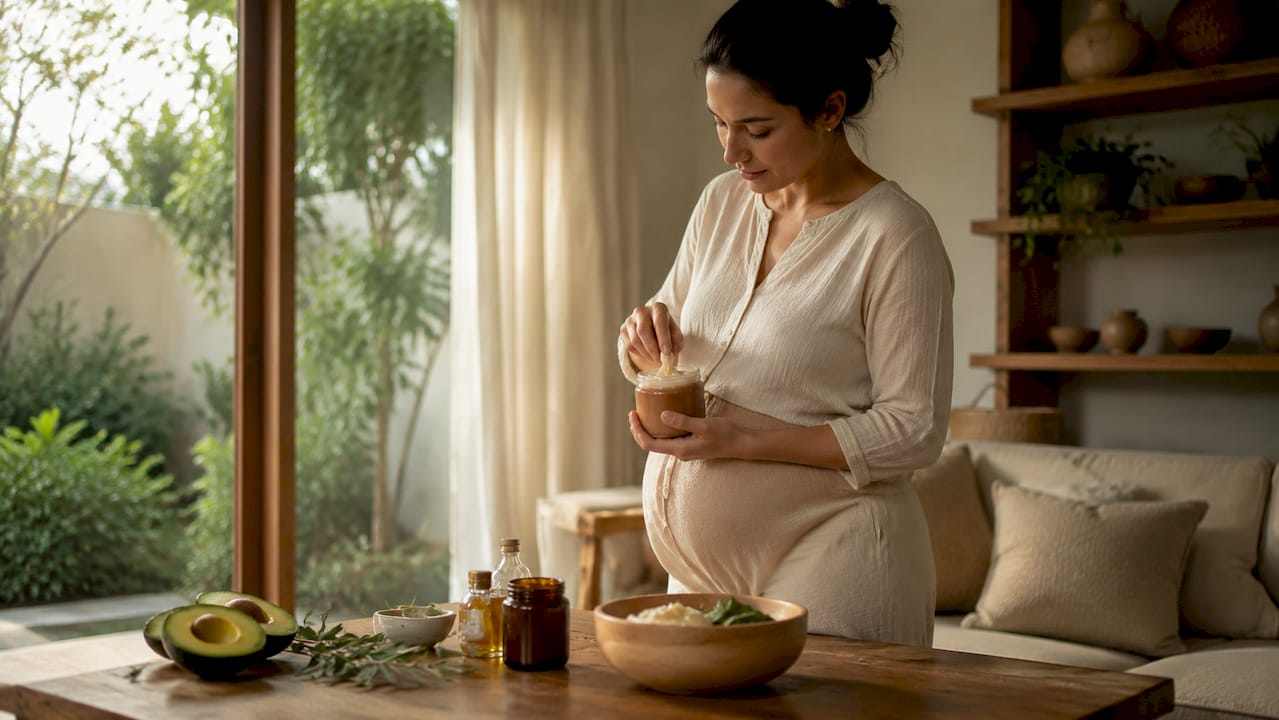
Barrier-active ingredients — ceramides, colloidal oatmeal, and niacinamide are recommended by dermatologists for pregnancy-reactive skin. Colloidal oatmeal in particular is excellent for itch relief on stretching skin.
A UK-specific note: because pregnancy raises the risk of melasma, pairing your moisturiser with a mineral SPF (non-nano zinc oxide) is a practical approach. Some tinted mineral moisturisers combine hydration and sun protection in one step, which suits the UK’s variable UV levels.
| Category | Ingredients | Key benefit | Pregnancy note |
|---|---|---|---|
| Humectants | Hyaluronic acid, glycerin, aloe vera | Draw water into skin | Well-tolerated; safe on face and body |
| Emollients | Jojoba, squalane, rosehip, avocado | Soften and smooth | Lighter oils for face; richer for bump |
| Occlusives | Shea butter, cocoa butter, beeswax | Seal moisture in | Excellent for bump and very dry areas |
| Barrier actives | Ceramides, colloidal oatmeal, niacinamide | Strengthen skin barrier; reduce itch | Ideal for sensitive or reactive skin |
| Sun protection | Non-nano zinc oxide | Protect against melasma | Prefer mineral over chemical filters |
- For itch: colloidal oatmeal or oat-based lotion applied after a warm shower
- For stretch-mark comfort: shea or cocoa butter layered over a glycerin mist
- For oily pregnancy skin: jojoba or squalane alone, no heavy butter needed
- For melasma support: a tinted mineral moisturiser with SPF 30 or above
4. What do ‘natural’ and ‘organic’ labels actually mean in the UK?
“Natural” is not a regulated legal term in the UK cosmetics market. Any brand can print it on a label without meeting a defined standard. That gap matters when you are pregnant and trying to make genuinely informed choices.
Third-party certifications are the practical alternative to trusting front-of-pack claims. Three marks are worth knowing:
- COSMOS Organic — verifies the percentage of organic and natural ingredients, prohibits certain synthetic ingredients, and requires traceability. It is the most widely recognised standard for organic cosmetics in the UK.
- MADE SAFE® — screens formulations against a list of known harmful chemicals. Useful for confirming that a product avoids a broad range of concerning actives.
- Leaping Bunny — confirms no animal testing at any stage of production. Not a safety certification per se, but a useful signal of brand transparency.
Certified organic brands in the UK frequently flag pregnancy suitability on their label pages and tend to offer fragrance-free and mineral SPF options for pregnant customers. That transparency is itself a useful buying signal.
When reading an INCI list, look for retinyl palmitate (often buried in firming or anti-ageing formulas), any entry ending in “-retinol” or “-retinyl”, and fragrance listed as “parfum” or “aroma.” High concentrations of essential oils appear near the top of the list.
Pro Tip: For highly reactive pregnancy skin, single-ingredient products are the easiest to verify. Grade A unrefined shea butter or cold-pressed jojoba oil has one ingredient on the label. There is nothing to scan for.
5. How do you choose a pregnancy-safe natural moisturiser?
A short checklist you can run through in a shop or while browsing online:
- Choose your texture first. Oily or combination skin does better with a lotion or a lightweight oil. Dry or very itchy skin needs a butter or balm.
- Check for fragrance-free. Look for “fragrance-free” on the front, then confirm the INCI list does not include “parfum” or “aroma.”
- Scan for retinyl palmitate. Search the INCI list for any word beginning with “retinyl” or “retinol.” If you find one, put it back.
- Look for a third-party mark. COSMOS Organic, MADE SAFE®, or Leaping Bunny on the label means someone other than the brand has checked the formulation.
- Match oil to area. Lighter oils (jojoba, squalane) for the face; richer oils (avocado, rosehip) or butters (shea, cocoa) for the bump and thighs.
- Patch test before committing. Apply a small amount to the inner arm and wait 24 hours before using it on larger areas.
- Ask your midwife or GP if you have a known allergy, very sensitive skin, or any persistent skin condition. A dermatologist referral is available through the NHS if needed.
6. How and where should you apply moisturiser during pregnancy?
Getting the application right matters as much as choosing the right product. Here is a simple sequence for introducing any new product safely.
Patch testing:
- Apply a small amount of the product to the inner forearm or behind the ear.
- Leave it uncovered for 24 hours.
- Watch for redness, itching, swelling, or any raised reaction.
- If no reaction appears after 24 hours, the product is likely well-tolerated for broader use.
Application by area:
- Bump: Apply oil or butter in gentle circular motions after a shower while skin is still slightly damp. This locks in moisture more effectively than applying to dry skin. The Mumbubhub Nourishing Body Oil is formulated for this purpose.
- Breasts: Use a fragrance-free, gentle formula. Avoid products with strong actives near the nipple area, particularly in the third trimester.
- Perineum: Perineal massage from around 34–36 weeks is commonly recommended by midwives to prepare the tissue. Use a dedicated perineal massage oil formulated for this area, not a general body product.
Consistent moisturising supports comfort and eases the itch of stretching skin. For realistic expectations on stretch marks, the evidence on prevention is limited — see Mumbubhub’s guide on stretch mark care during pregnancy for an honest summary.
Pro Tip: If a product contains a small amount of essential oil and you choose to use it, avoid applying it to broken or very sensitive skin and keep concentrations low. Fragrance-free is always the lower-risk choice during pregnancy.
If you develop a persistent rash, unusual skin reaction, or any concern about a product, stop using it and speak to your midwife or GP before reintroducing it.
7. Common myths about natural pregnancy skincare
A few misconceptions circulate widely enough to be worth addressing directly.
- Myth: “Natural means safe.” Fact: poison ivy is natural. Concentrated essential oils, high-dose plant acids, and certain herbal extracts can all cause reactions or carry precautionary warnings in pregnancy. Natural origin does not equal automatic safety.
- Myth: “All essential oils are fine in pregnancy.” Fact: NHS-affiliated practitioners advise avoiding therapeutic-strength essential oil blends during pregnancy. Low concentrations in a rinse-off product are a different matter to a concentrated aromatherapy blend applied directly to skin.
- Myth: “Body retinol is always dangerous.” Fact: topical body retinyl palmitate carries lower systemic risk than oral retinoids. UK guidance still recommends avoiding it as a precaution, but a single accidental application before you knew you were pregnant is not a cause for alarm. Speak to your midwife if you are concerned.
- Myth: “Expensive products are safer.” Fact: price has no relationship to ingredient safety. A £4 pot of unrefined shea butter with one ingredient on the label is easier to verify than a £60 “natural” serum with 30 ingredients.
The UK context adds one more layer: sun protection. Pregnancy raises the risk of melasma (the “mask of pregnancy”), and the British Skin Foundation recommends mineral SPF for daily use. A tinted mineral moisturiser with mineral SPF covers hydration, pigmentation protection, and light coverage in one product.
8. How are pregnancy skincare products regulated in the UK?
Cosmetic products sold in Great Britain are regulated under the UK Cosmetics Regulation, which requires that all products placed on the market are safe for human health under normal or reasonably foreseeable conditions of use. Every product must have a safety assessment completed by a qualified person before it goes on sale.
What this means in practice: manufacturers are legally required to list all ingredients in INCI (International Nomenclature of Cosmetic Ingredients) order on the label, from highest to lowest concentration. This is the list you scan for retinyls, fragrance, and high essential-oil concentrations.
The regulation does not create a specific “pregnancy-safe” category. That determination is left to the safety assessor and, ultimately, to the consumer. This is why third-party certifications and transparent INCI lists matter so much. The NHS advises checking with a pharmacist or GP if you are unsure about a specific ingredient during pregnancy.
9. How to source and verify genuinely natural moisturisers in the UK
The UK market has a wide range of products claiming to be natural or organic. Verifying those claims takes a few minutes but saves a lot of guesswork.
Start with the INCI list, not the front of pack. The front label is marketing; the INCI list is the legal record of what is actually in the product. Ingredients appear in descending order of concentration, so the first five or six entries make up the bulk of the formula.
Use the COSMOS Organic database. COSMOS-certified brands are listed on the COSMOS website. If a brand claims COSMOS certification, you can verify it independently rather than taking the label at face value.
Buy from brands that publish full INCI lists online. Reputable UK natural brands publish their full ingredient lists on product pages, not just on the physical label. If a brand’s website does not show the INCI list, that is a reason to look elsewhere.
Check for pregnancy-specific flagging. Some UK brands explicitly note on product pages whether a formula is suitable during pregnancy. This is not a legal requirement, but it signals that the brand has considered the question and is willing to be transparent about it.
Consider single-ingredient or very short-formula products. Cold-pressed oils (jojoba, sweet almond, rosehip) and unrefined butters (shea, cocoa) sold by reputable UK suppliers are among the easiest products to verify. A natural pregnancy skincare routine built around a handful of verified single-ingredient products is often simpler and safer than a shelf full of multi-ingredient formulas.
Sweet almond oil deserves a specific note: it is widely used in pregnancy massage and body products, but it is a tree nut derivative. If you have a nut allergy, check with your GP before using it.
Key takeaways
Natural pregnancy moisturisers are generally safe when you choose fragrance-free, barrier-supportive formulas, avoid retinoids and high-dose salicylic acid, and verify ingredients via the INCI list and third-party certifications.
| Point | Details |
|---|---|
| Avoid retinoids and retinyls | Retinyl palmitate appears in firming creams; UK guidance recommends avoiding it as a precaution during pregnancy. |
| Favour barrier-supportive ingredients | Ceramides, colloidal oatmeal, hyaluronic acid, shea butter, and jojoba oil are well-tolerated and effective. |
| ‘Natural’ is not regulated | Look for COSMOS Organic, MADE SAFE®, or Leaping Bunny marks rather than relying on front-of-pack claims. |
| Patch test every new product | Apply to the inner arm, wait 24 hours, and check for any reaction before using on larger areas. |
| Mumbubhub for ready-made options | Mumbubhub’s Pregnancy Belly Balm, Nourishing Body Oil, and Perineal Massage Oil are formulated to meet the safety checklist above. |
The case for keeping it simple
There is a tendency in pregnancy to treat skincare as a problem to solve with the right product. The reality is more straightforward. Hormonal changes make skin more reactive, not more demanding. The best response is usually subtraction: fewer ingredients, no fragrance, no actives you cannot verify.
What gets overlooked is how much the format matters. A body butter applied to damp skin after a shower outperforms a sophisticated serum applied to dry skin, not because the butter is better formulated, but because the application method is. Moisture retention is mostly about timing and occlusion, not ingredient complexity.
The other thing worth saying plainly: no moisturiser prevents stretch marks. The evidence on this is consistent and has been for years. What moisturising does do is reduce itch, support skin comfort as it stretches, and give you a daily ritual that feels genuinely good during a physically demanding time. That is worth doing. Just do not buy a product on the promise of something it cannot deliver.
Mumbubhub’s pregnancy-safe natural products
If you want ready-made products that already meet the checklist in this article, Mumbubhub has three that are worth knowing about.
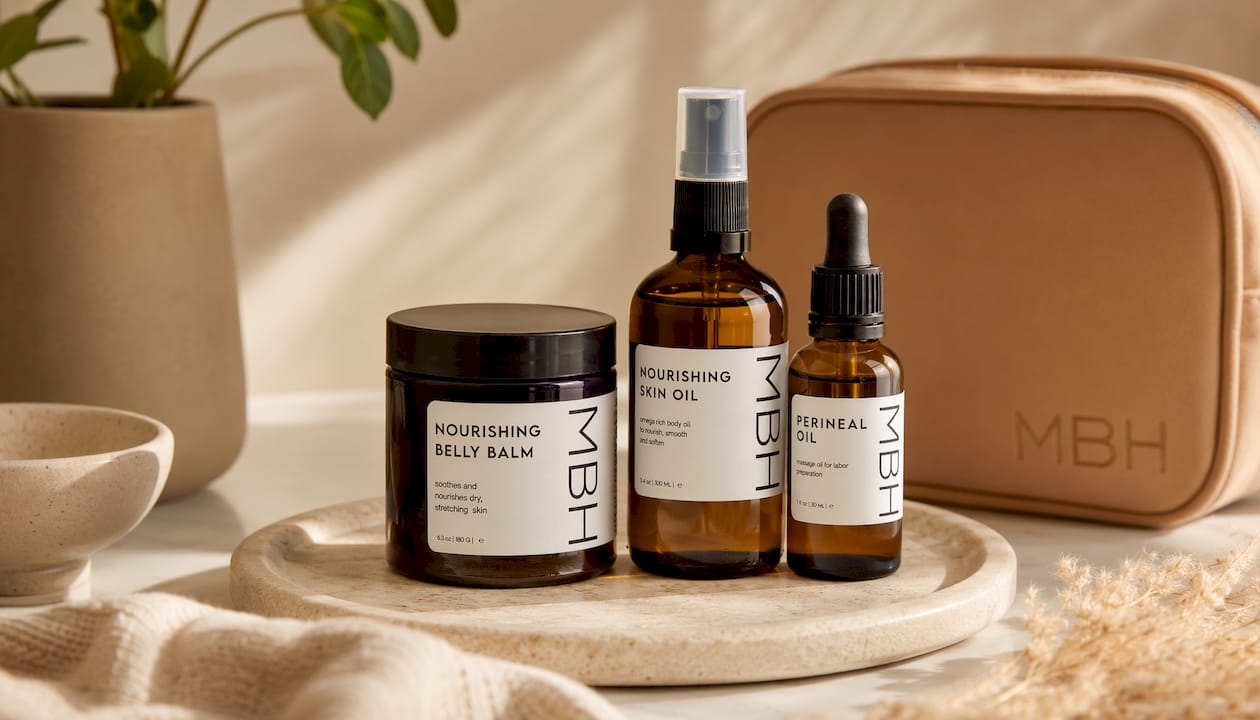
The Pregnancy Belly Balm is a daily-use balm formulated for the bump, combining plant butters and gentle botanicals in a short, verifiable ingredient list. The Nourishing Body Oil is built around natural plant oils suited to bump and body massage, applied to damp skin for best absorption. For perineal preparation from around 34 weeks, the Perineal Massage Oil is specifically formulated for that area, with an ingredient list you can check against the guidance above.
As with any product, patch test first and check the full INCI list on each product page before use. If you have a known allergy or a skin condition, speak to your midwife before introducing new products. Mumbubhub publishes full ingredient lists on every product page so you can verify before you buy.
Useful sources
- UK government guidance on retinoid medicines and pregnancy — the primary UK source on retinoid avoidance in pregnancy, including topical products
- UK Cosmetics Regulation (gov.uk) — the legal framework governing cosmetic product safety and labelling in Great Britain
- British Skin Foundation — sun protection — guidance on mineral SPF and melasma prevention relevant to pregnancy
- York Hospitals NHS Foundation Trust — essential oil cautions — NHS-affiliated guidance on essential oil use during pregnancy
- NHS — health things to know in pregnancy — broad NHS guidance on what to avoid during pregnancy, including skincare considerations
- Consult your midwife or GP for personalised advice on any ingredient or product you are unsure about.
FAQ
What natural moisturisers are safe to use during pregnancy?
Lotions, body butters, and oils containing ceramides, hyaluronic acid, shea butter, jojoba, squalane, colloidal oatmeal, and glycerin are all considered safe for most pregnant women. Choose fragrance-free formulas and verify the INCI list for retinyls before buying.
Which moisturiser is best for the bump during pregnancy?
A body butter or balm containing shea or cocoa butter, applied to damp skin after a shower, is one of the most effective options for the bump. Mumbubhub’s Pregnancy Belly Balm is formulated specifically for daily bump use with a short, verifiable ingredient list.
What moisturising creams should you avoid during pregnancy?
Avoid any product containing retinoids, retinol, or retinyl palmitate, high-dose salicylic acid, concentrated essential oil blends, and synthetic fragrance. Firming and anti-cellulite creams are the most likely to contain retinyls, so check those labels carefully.
Is ‘natural’ skincare automatically safe in pregnancy?
No. “Natural” is not a regulated term in the UK, and some natural ingredients (concentrated essential oils, certain plant acids) carry precautionary warnings in pregnancy. Look for COSMOS Organic, MADE SAFE®, or Leaping Bunny certification and read the full INCI list rather than relying on front-of-pack claims.