

The role of maternal mental health support explained
Maternal mental health support is defined as the range of professional, social, and practical interventions that protect a mother’s emotional and psychological wellbeing during pregnancy and the postpartum period. The clinical term for this field is perinatal mental health care, covering the period from conception through to the first year after birth. Mental health conditions are the most common complication of pregnancy and childbirth, affecting at least one in five mothers annually. These conditions account for 27.7% of pregnancy-related deaths, yet 75% of affected mothers receive no care at all. That gap is not a personal failing. It is a systemic problem that good support structures exist to close.
The Maternal Mental Health Alliance and NHS perinatal mental health guidelines both recognise that untreated anxiety, depression, and birth trauma carry serious consequences for mothers and their babies. Perinatal mental health care integration into standard antenatal services is now considered essential, not optional, because of the female fetal brain’s vulnerability to prenatal distress and the intergenerational risks that follow. Understanding the role of maternal mental health support means understanding that it protects two lives at once.
What are the benefits of maternal mental health support?
Good maternal mental health care produces measurable improvements for both mothers and babies. For mothers, consistent support reduces symptoms of postnatal depression and anxiety, improves sleep quality, and strengthens a mother’s sense of confidence in her own parenting. These are not minor quality-of-life gains. They are the foundation on which a healthy family is built.
The effects on babies are equally significant. Prenatal distress affects fetal brain development, with consequences that can persist into childhood and beyond. Mothers who receive adequate support are more likely to breastfeed successfully and to form secure attachments with their babies. Secure attachment in infancy is one of the strongest predictors of positive neurocognitive and emotional development in later life.
“Effective maternal mental health support does not just treat illness. It actively builds the emotional conditions in which both mother and baby can thrive. The evidence is clear: early, consistent support changes outcomes across generations.”
Partner support is the most effective form of social support for new mothers, increasing maternal self-efficacy and improving mother-infant bonding. Strong partner involvement also reduces the risk of depression and anxiety in the postpartum period. This finding matters because it shifts the conversation away from the idea that mental health support is solely a clinical responsibility.
- Reduced symptoms of postnatal depression and anxiety
- Stronger mother-infant bonding and secure attachment
- Improved breastfeeding rates and duration
- Greater maternal confidence and self-efficacy
- Better neurocognitive outcomes for children
What forms does maternal mental health support take?
Support for new mothers and expectant mothers exists across a spectrum, from specialist clinical care to everyday practical help. Knowing what is available makes it far easier to ask for what you need.
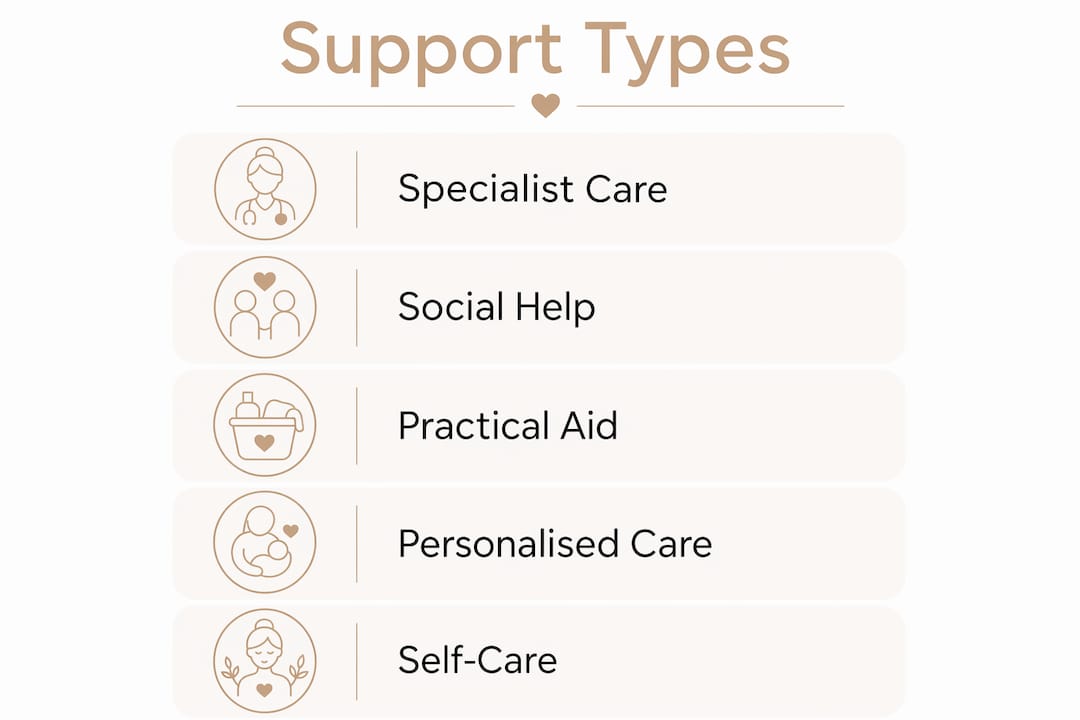
Professional and clinical support
Perinatal mental health clinics offer specialist assessment and treatment for conditions including postnatal depression, obsessive-compulsive disorder, post-traumatic stress disorder, and postpartum psychosis. Embedding mental health support directly in obstetric clinics with multidisciplinary teams, including psychiatric consultants, therapists, and certified coaches, improves timely access to care within one week of referral. Hybrid models combining in-person and telehealth appointments make this care accessible to mothers who cannot easily travel.

Postpartum care guidelines recommend mental health screening with follow-ups within 24–48 hours and 7–14 days after birth. Best practice involves collaboration among nursing staff, lactation consultants, and mental health professionals. Routine screening at these intervals catches problems early, before they escalate.
Social and partner support
Support for new mothers manifests in many forms, from meal planning and shared parenting duties to professional counselling and consistent check-ins. The research is clear that this support works best when it is discussed and planned ahead of time, rather than offered reactively in a crisis. Waiting until a mother is struggling to organise help is too late.
- Talk to your partner or a trusted person before the baby arrives. Agree on specific tasks, not vague offers of help. “I will handle the night feeds on Tuesdays and Thursdays” is more useful than “just ask if you need anything.”
- Contact your midwife or health visitor. They are trained to spot early signs of perinatal mental health difficulties and can refer you to specialist services quickly.
- Ask your GP about local perinatal mental health services. NHS provision varies by region, but most areas now have dedicated teams.
- Consider tele-mental health options. Video therapy and phone-based support remove the need to travel with a newborn and reduce the barrier of exhaustion.
- Accept practical help from your community. Meals, school runs for older children, and company during the day all reduce the cognitive load that worsens anxiety and low mood.
Pro Tip: Write a postpartum support plan during your third trimester. List who will help with what, and share it with your partner, family, and midwife. Having it written down removes the burden of asking in the moment.
Home-based interventions reduce logistical burdens and maternal fatigue, improving postpartum mental wellbeing and mother-child interactions. Home visits allow continuous psychological care, particularly for mothers with mobility challenges or those in rural areas.
How does personalised care improve maternal mental health outcomes?
Effective maternal mental health care is not one-size-fits-all. Personalised support that balances privacy preferences and cultural context consistently outperforms rigid, standardised approaches. A mother who feels that her values and comfort have been considered is far more likely to engage with and benefit from the support offered.
Barriers to accessing care are real and varied. Stigma remains one of the most significant. Many mothers fear being judged as incapable or worry that expressing distress will raise concerns about their parenting. Language barriers, lack of childcare, financial constraints, and cultural expectations around self-sufficiency all reduce the likelihood of a mother seeking help. Recognising these barriers is the first step to dismantling them.
- Stigma: Normalising conversations about perinatal mental health in antenatal appointments reduces shame and increases help-seeking.
- Cultural context: Support that acknowledges a mother’s cultural background and family structure is more likely to be accepted and effective.
- Privacy preferences: Some mothers prefer one-to-one therapy; others benefit more from group support or peer networks. Both are valid.
- Flexibility: Offering a mix of in-person, home visit, and telehealth options removes the assumption that all mothers can access a clinic easily.
Pro Tip: If a particular type of support does not feel right for you, say so. A good practitioner will adapt. You are not obliged to accept a form of care that does not suit your circumstances or values.
The importance of maternal wellness is not abstract. When a mother feels seen and supported in a way that fits her life, she is more likely to sustain that support over time, which is where the real benefit accumulates.
How do you access and integrate maternal mental health support?
Accessing support works best when it is treated as a routine part of pregnancy care, not a last resort. The steps below give you a practical framework for building that support into your life before and after birth.
- Attend all routine antenatal appointments. These are your primary opportunity for screening and referral. Tell your midwife honestly how you are feeling emotionally, not just physically.
- Ask about the Edinburgh Postnatal Depression Scale. This is the standard screening tool used by NHS midwives and health visitors. Completing it honestly gives your care team the information they need to help you.
- Involve your partner actively. Partner involvement reduces depression risk and strengthens the mother-infant bond. Ask your partner to attend at least one antenatal appointment focused on emotional wellbeing.
- Build a self-care routine. Physical self-care, including rest, gentle movement, and skin-to-skin rituals, supports mental health by reducing cortisol and creating moments of calm. Mumbubhub’s postpartum recovery essentials include natural products designed to make these rituals feel restorative rather than effortful.
- Review your support plan at six weeks postpartum. Needs change. What worked in the first week may not be sufficient at six weeks, and professional support may need to be added or adjusted.
| Support type | When to use it | Who provides it |
|---|---|---|
| Midwife-led screening | Antenatal and postnatal appointments | NHS midwife or health visitor |
| Perinatal mental health clinic | Moderate to severe symptoms | NHS specialist team or GP referral |
| Tele-mental health therapy | Ongoing support, limited mobility | Private or NHS video therapy |
| Home visiting service | Early postpartum, mobility challenges | Health visitor or specialist nurse |
| Partner and family support | Daily, ongoing | Partner, family, and community |
Combining professional care with self-care tips for new mums creates a layered approach. Neither replaces the other. Together, they address both the clinical and the everyday dimensions of maternal wellbeing.
Key takeaways
Maternal mental health support is most effective when it starts early, involves partners, and is personalised to fit each mother’s circumstances and cultural context.
| Point | Details |
|---|---|
| Start support early | Perinatal mental health care should begin in pregnancy, not after symptoms appear. |
| Partner involvement matters | Strong partner support reduces depression risk and improves mother-infant bonding. |
| Personalise your care | Rigid approaches fail; match support type to your values, culture, and practical needs. |
| Use routine screening | The Edinburgh Postnatal Depression Scale is a standard NHS tool; complete it honestly. |
| Combine professional and self-care | Clinical support and daily self-care routines work together to protect maternal wellbeing. |
What I have learned about asking for help
There is a particular kind of guilt that settles on new mothers who feel they are not coping. I have seen it described by mothers across every background and circumstance, and the pattern is always the same. They believe that needing help means they are failing. Accepting help is actually a protective factor that significantly benefits mental health in the fourth trimester. The guilt is not a signal that something is wrong with you. It is a signal that the cultural narrative around motherhood is wrong.
The mothers I have seen thrive are not the ones who managed everything alone. They are the ones who built a support structure before they needed it desperately. They told their midwife the truth. They let their partner take the night feeds. They accepted the casserole from a neighbour. These are not signs of weakness. They are signs of good judgement.
My honest advice is this: treat asking for support the same way you treat attending your antenatal scans. It is not optional. It is part of caring for yourself and your baby. The research backs this up entirely, and so does every mother who has come out the other side of a difficult postpartum period with her mental health intact.
— Nat
How Mumbubhub supports your wellbeing alongside mental health care
Self-care is not a substitute for professional mental health support. It is a daily practice that keeps your nervous system regulated and gives you moments of genuine rest. Mumbubhub’s range of natural, plant-based products is designed with exactly that in mind.
The pregnancy essentials collection includes bump oils, belly balms, and bath soaks formulated without harsh chemicals, so you can build a calming ritual that feels safe at every stage. For postpartum recovery, the self-care and wellness range offers herbal bath soaks, pillow sprays, and soaking salts that support physical healing and emotional calm. A portion of every Mumbubhub purchase goes towards maternal health initiatives, so your self-care also contributes to wider support for mothers.
FAQ
What is perinatal mental health support?
Perinatal mental health support covers professional, social, and practical care for a mother’s emotional wellbeing from conception through to the first year after birth. It includes screening, therapy, partner support, and home visiting services.
How common are mental health problems during pregnancy and after birth?
Mental health conditions affect at least one in five mothers during pregnancy or the postpartum period, making them the most common complication of childbirth. Despite this, the majority of affected mothers do not receive any care.
When should I seek help for my mental health during or after pregnancy?
Seek help as soon as you notice persistent low mood, anxiety, or difficulty bonding with your baby. Postpartum screening guidelines recommend follow-up within 24–48 hours and again at 7–14 days after birth, so early contact with your midwife or GP is the right first step.
How can my partner support my mental health after birth?
Partner support is the most effective social support for new mothers, reducing depression risk and strengthening the mother-infant bond. Practical involvement in feeding, night care, and household tasks makes a measurable difference to maternal wellbeing.
Does self-care actually help with postpartum mental health?
Self-care routines, including rest, gentle movement, and calming physical rituals, reduce cortisol and support emotional regulation. They work best as a complement to professional support, not a replacement for it.