

Mastitis natural relief for breastfeeding mums
TL;DR:
- Managing mastitis involves frequent feeding or expressing from the affected breast and applying cold therapy after each session. If symptoms persist beyond two days or worsen, it is essential to contact healthcare providers promptly. Following these measures typically alleviates most cases within a few days and supports ongoing breastfeeding.
The three things to do right now: keep feeding (or expressing) from the affected breast, take ibuprofen to reduce inflammation, and apply a cold compress or chilled cabbage leaf after each feed. NHS guidance is clear that most cases improve within a couple of days with these measures. If you are not improving by that point, or if you develop a high fever, spreading redness, or feel severely unwell, contact NHS 111 or your GP the same day.
Do this now:
- Feed or express from the sore breast first at every feed.
- Take ibuprofen (400 mg with food, up to three times daily) unless contraindicated.
- Apply a cold compress or chilled cabbage leaf for up to 20 minutes after feeding.
- Rest as much as you possibly can.
- Drink plenty of water.
Pro Tip: If your areola is so swollen that your baby cannot latch, try reverse pressure softening: place your fingertips around the base of the nipple and apply firm, steady pressure for about one minute. This temporarily moves fluid back into the breast tissue so your baby can attach properly.
Table of Contents
- What mastitis is and why continuing to feed helps
- Your step-by-step home remedy plan for mastitis
- Herbs, supplements and other approaches: what the evidence actually says
- What clinical guidelines actually say
- How to reduce the risk of mastitis recurring
- When to seek medical help: red flags and NHS escalation
- Key takeaways
- A note from Nat
- Comfort and rest support from Mumbubhub
- Useful sources
- FAQ
What mastitis is and why continuing to feed helps
Mastitis is an inflammatory condition of the breast, most commonly caused by slowed or obstructed milk flow. It may or may not involve bacterial infection. The two main pathways are a blocked duct (milk backs up, causing localised inflammation) and bacterial mastitis (bacteria, usually Staphylococcus aureus, enter through a cracked nipple and cause infection on top of the inflammation).
Common triggers include a poor latch or positioning that does not drain the breast fully, oversupply, sudden changes in feeding frequency, tight bras or clothing that compress breast tissue, and returning to work with longer gaps between feeds.
Symptoms typically include a firm, tender area in one breast, redness and warmth over that area, and a general flu-like feeling with fatigue, aching muscles, and fever. The fever is the key distinguishing sign between simple blocked duct and probable infective mastitis, though both benefit from the same initial home care.
“Breast milk from an infected breast is not harmful to your baby. Continuing to breastfeed is usually recommended and helps clear the blockage.” — NHS
La Leche League echoes this: feeding on cue keeps milk moving and is one of the most effective things you can do in the first hours of an episode.
Your step-by-step home remedy plan for mastitis
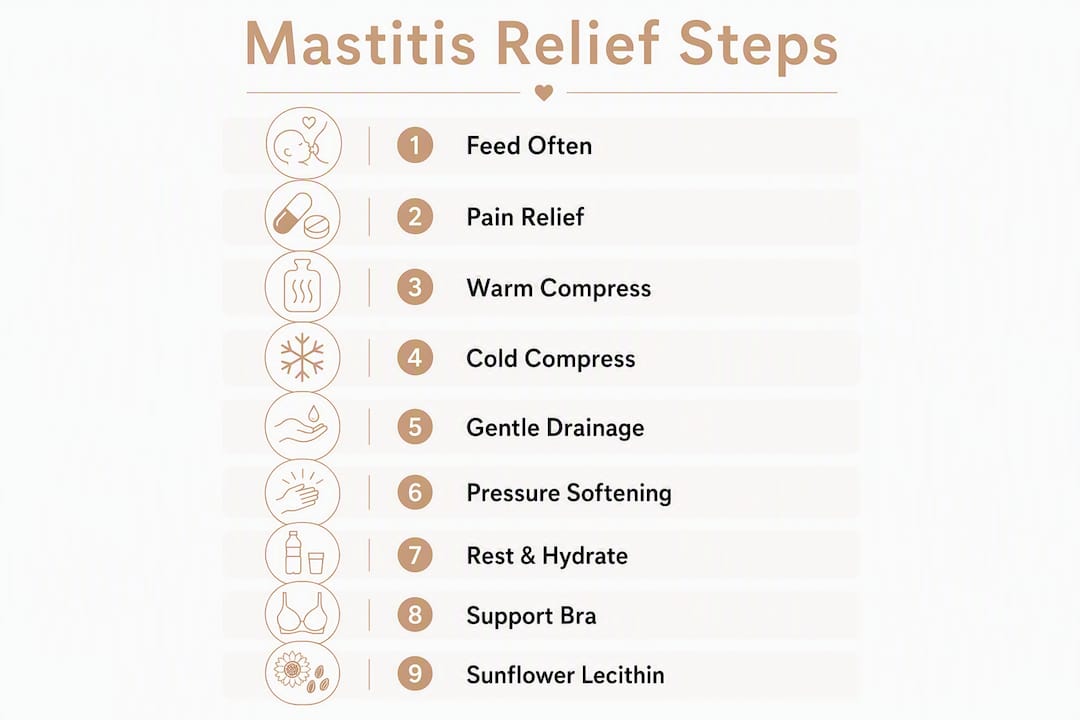
1. Keep milk moving first
Feed on cue, starting on the affected side. Varying your feeding position helps drain different parts of the breast. If latching is painful or your baby refuses the breast, hand-express or pump just enough to soften the areola before offering again. Avoid pumping aggressively to “empty” the breast; that signals your body to produce more milk and can worsen engorgement.
2. Anti-inflammatory pain relief
Ibuprofen is the preferred OTC option because it reduces both pain and tissue inflammation. Paracetamol relieves pain but has no anti-inflammatory effect. Both are safe to take while breastfeeding per NHS guidance. Standard adult ibuprofen dosing (400 mg with food, up to three times daily) is appropriate unless you have a reason to avoid NSAIDs. Take it regularly in the initial days rather than waiting until pain peaks.

3. Warm compress before feeding
A warm flannel or heat pack applied to the breast for a few minutes before a feed can help milk flow more easily. Keep it comfortably warm, not hot. This is a comfort measure, not a treatment for the inflammation itself, so do not apply heat between feeds.
4. Cold compress or chilled cabbage leaves after feeding
After each feed, apply a cold compress or a chilled green cabbage leaf for up to 20 minutes. Studies show that chilled cabbage leaves are roughly as effective as cold gel packs for reducing breast pain and engorgement. Use them up to three times daily, but no more: prolonged cabbage leaf use may reduce milk supply.
| Warm compress | Cold compress / cabbage leaf | |
|---|---|---|
| When to use | Immediately before a feed | Immediately after a feed |
| Mechanism | Encourages milk flow and eases let-down | Reduces swelling and inflammation |
| Duration | 2–5 minutes | Up to 20 minutes |
| Frequency | Before each feed | Up to 3× daily |
| Caution | Do not use between feeds (may worsen engorgement) | Limit cabbage to 3× daily to protect supply |
5. Gentle lymphatic drainage, not deep massage
La Leche League and the Academy of Breastfeeding Medicine both advise against deep massage or vibrating devices. Instead, use very light strokes: starting from the outer breast, sweep gently toward the armpit and chest wall, using about the same pressure you would use to stroke a cat. This encourages lymphatic drainage without traumatising already-inflamed tissue. Do this for a minute or two before feeding, not instead of it.
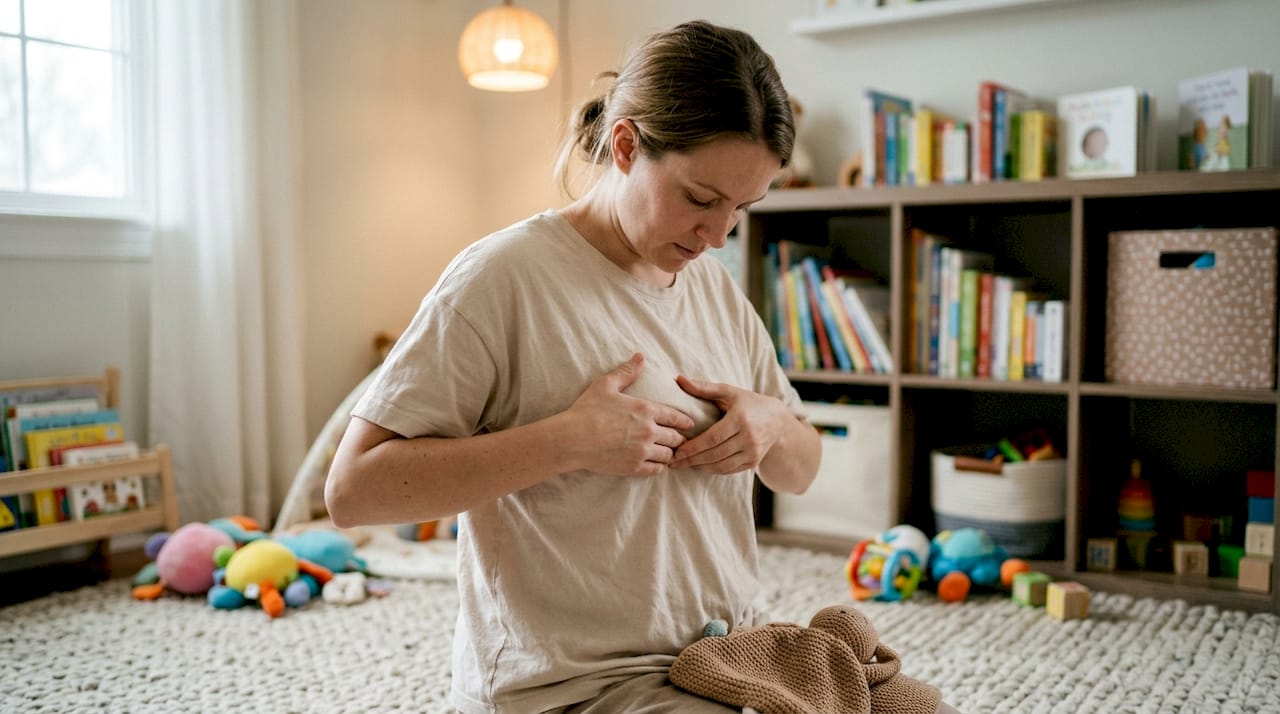
6. Reverse pressure softening for latch difficulties
If swelling around the areola is making it hard for your baby to latch, reverse pressure softening (RPS) is a quick fix. Press your fingertips firmly around the base of the nipple and hold for about one minute. The pressure temporarily moves oedema back into the breast, creating a softer areola your baby can grasp.
7. Rest and hydration
Rest is not optional. Mastitis behaves like a systemic inflammatory illness, and your body needs sleep to recover. Ask your partner, a family member, or a friend to take the baby between feeds. Drink water consistently throughout the day; dehydration thickens milk and makes drainage harder.
8. Supportive bra and clothing
Wear a well-fitting, non-underwired bra that does not compress the breast. Tight clothing is one of the most overlooked triggers for recurrent blocked ducts. If you sleep in a bra, check that it is not digging in overnight.
9. Sunflower lecithin for recurrent plugged ducts
If you have had multiple episodes of blocked ducts, sunflower lecithin is worth discussing with a lactation consultant. La Leche League guidance suggests 1,200 mg capsules taken three to four times daily (3,600–4,800 mg total) while symptoms persist, tapering as they resolve. Use it as a short-term measure rather than a permanent daily supplement; prolonged use without specialist input is not well studied.
Pro Tip: Position your baby so their chin points toward the blocked area of the breast. Gravity and jaw pressure from that direction will drain the affected quadrant more effectively than any massage.
Herbs, supplements and other approaches: what the evidence actually says
Many natural remedies are discussed online for mastitis. Some have a plausible rationale; others carry real risks for breastfeeding mothers. Here is a plain summary.
| Remedy | Evidence level | Safety note for breastfeeding |
|---|---|---|
| Chilled cabbage leaves | Moderate (comparable to cold packs in trials) | Safe; limit to 3× daily to protect supply |
| Sunflower lecithin | Low-moderate (lactation consensus) | Generally considered safe short-term |
| Probiotics (Lactobacillus fermentum) | Preliminary; some trial data | Generally considered safe |
| Vitamin C | Theoretical anti-inflammatory; no mastitis-specific trials | Safe at standard dietary doses |
| Garlic | Antimicrobial in vitro; no clinical mastitis trials | Safe in food amounts |
| Essential oils (e.g. tea tree) | No clinical evidence for mastitis | Do not apply near the nipple. Infants may ingest residues. Requires heavy dilution if used on skin away from the breast. |
| Charcoal or castor oil poultices | No clinical evidence | Avoid near the nipple; skin irritation risk |
| Herbal tinctures (e.g. echinacea, fenugreek) | No mastitis-specific evidence | Check each herb individually for breastfeeding safety and drug interactions before use |
Safety caution: if you are considering any topical product near the breast, check ingredient safety for breastfeeding. The postpartum skincare FAQs at Mumbubhub cover common ingredient questions. For guidance on natural ingredients and sensitive skin, Rose Petal Glam’s ingredient guide is a useful reference.
Stop any natural approach and contact a clinician if you notice spreading redness, red streaks radiating from the breast, worsening fever, or a hard lump that is not softening with feeding.
What clinical guidelines actually say
The current consensus from NHS, La Leche League, and the Academy of Breastfeeding Medicine Protocol #36 treats mastitis primarily as an inflammatory condition. The priorities are controlling inflammation and keeping milk moving, not forceful duct “unblocking.”
“Modern lactation medicine prioritises anti-inflammatory measures (NSAIDs, cold therapy) and gentle milk removal over aggressive massage or pumping, which can worsen tissue trauma.” — Academy of Breastfeeding Medicine Protocol #36
| Measure | Recommended approach | Source |
|---|---|---|
| Cabbage leaves | Up to 20 minutes, up to 3× daily | Healthline / trial data |
| Reverse pressure softening | ~1 minute of firm areola pressure | HSE guidance |
| Expected improvement window | a couple of days of home care | NHS |
| Sunflower lecithin (recurrent plugs) | 3,600–4,800 mg daily while symptomatic | La Leche League |
| Ibuprofen | Preferred OTC anti-inflammatory; safe while breastfeeding | NHS |
Many cases of mastitis resolve without antibiotics when managed early and correctly. Antibiotics become necessary when systemic infection or abscess is suspected, or when home care has not produced improvement within a couple of days.
How to reduce the risk of mastitis recurring
Prevention comes down to consistent feeding technique and a few practical habits.
- Check latch and positioning at every feed. A shallow latch is the single most common cause of recurring blocked ducts. A lactation consultant can spot and correct positioning issues in one session.
- Rotate feeding positions. Varying positions throughout the day drains different quadrants of the breast and prevents milk from pooling in one area.
- Avoid tight bras and clothing. Underwired bras, tight sports bras worn overnight, and bag straps that press on the breast are all common culprits.
- Do not over-pump. Expressing more than your baby needs signals your body to produce more milk, increasing engorgement risk. Express only to comfort if you need to.
- Wean gradually if stopping breastfeeding. Sudden cessation is a significant mastitis trigger; drop one feed every few days to allow supply to adjust.
- Consider probiotics. Some lactation research points to Lactobacillus fermentum as potentially helpful for recurrent mastitis, though evidence is still preliminary.
- Use lecithin as needed, not routinely. If you have had three or more blocked duct episodes, discuss short-term lecithin with a lactation consultant rather than starting it indefinitely.
Pro Tip: Sleep matters more than most mothers expect. Fatigue suppresses immune function and is a consistent background factor in mastitis recurrence. Even one extra sleep block of 90 minutes per day, taken when the baby naps, can make a measurable difference to recovery speed and recurrence risk. Building a postpartum self-care ritual around rest is not indulgent; it is clinical.
When to seek medical help: red flags and NHS escalation
Home care is appropriate for mild to moderate mastitis in the first 24–48 hours. Beyond that window, or if any of the following appear, contact a clinician promptly.
Red flags requiring same-day contact with NHS 111 or your GP:
- Symptoms not improving after 24–48 hours of home care
- Fever above 38°C that is not settling
- Redness spreading beyond the original area
- Red streaks radiating from the breast toward the armpit
- A hard, painful lump that is not softening with feeding (possible abscess)
- Feeling severely unwell, confused, or unable to care for yourself or your baby
What to do:
- Call NHS 111 if your GP surgery is closed or you are unsure whether to wait.
- Book a same-day or next-day GP appointment if symptoms are worsening but you are not severely unwell.
- Go to A&E or call 999 only if you are experiencing signs of sepsis: extreme confusion, rapid breathing, mottled skin, or collapse.
“If you have mastitis and your symptoms are not improving within 24 hours of home treatment, see your GP. You may need antibiotics.” — NHS
Antibiotics prescribed for mastitis are generally compatible with continued breastfeeding. Your GP will choose an appropriate antibiotic; do not stop feeding unless specifically advised to.
This article provides general information, not medical advice. Always confirm current guidance with NHS 111, your GP, or a qualified lactation consultant.
Key takeaways
Most mastitis episodes respond to early, consistent home care: keep milk moving, reduce inflammation, and rest.
| Point | Details |
|---|---|
| Keep feeding or expressing | Continued milk removal from the affected breast is the single most important step. |
| Use cold after feeds | Chilled cabbage leaves or a cold compress for up to 20 minutes, up to 3× daily, reduces swelling. |
| Take ibuprofen regularly | Ibuprofen is the preferred OTC option; take it consistently for the first 24–48 hours, not just when pain peaks. |
| Expect improvement in 24–48 hours | No improvement within this time means same-day contact with NHS 111 or your GP. |
| Mumbubhub for adjunct comfort | The Rest & Restore Bundle and Postpartum Essentials Bundle support rest and skin comfort during recovery. |
A note from Nat
There is something particularly cruel about mastitis. You are already exhausted, you are trying to do the best thing for your baby, and then your body turns on you with what feels like the flu plus a hot poker in your chest. The advice to “just keep feeding” can feel almost insulting when every latch is agony.
What I want you to take from this article is that the evidence genuinely supports the simple measures. Cold, ibuprofen, gentle drainage, rest. Not because they are the easy answer, but because they address what is actually happening in the tissue. The shift in lactation medicine away from aggressive massage and forceful pumping is not a minor update; it reflects a real change in how we understand the condition.
The products Mumbubhub offers are not mastitis treatments. They are comfort tools for a body under stress: a soothing ritual, a moment of warmth that is not about milk production, a small act of care for yourself. That matters too. Recovery is not just physical.
If you are unsure at any point, call NHS 111 or speak to a lactation consultant. La Leche League has a helpline and trained volunteers who have been through this themselves.
Comfort and rest support from Mumbubhub
Mastitis recovery asks a lot of your body. The clinical work is feeding, cold therapy, and ibuprofen. But rest, skin comfort, and a calmer nervous system genuinely support the process, and that is where Mumbubhub comes in.
The Rest & Restore Bundle is built around sleep and recovery: a pillow spray, soaking salts, and a body oil formulated with plant-based ingredients, all safe for postpartum use. The Postpartum Essentials Bundle covers the broader recovery kit, from herbal bath soaks to nipple balm, for the days when your body needs gentle, chemical-free care. Neither product is a medical treatment. Both are designed to make the hours between feeds a little more restorative. If you are building a postnatal recovery kit, these bundles are a practical starting point. Browse the full range and find what fits your recovery at Mumbubhub.
Useful sources
The following resources were used in preparing this article and are worth bookmarking for further reading.
- NHS: Mastitis — UK escalation rules, OTC medication guidance, and when to seek antibiotics.
- La Leche League: Mastitis, slowed milk flow, and milk blisters — Practical lymphatic drainage steps, cabbage leaf guidance, and lecithin dosing.
- Academy of Breastfeeding Medicine Protocol #36 — Clinical protocol underpinning the shift to gentle, anti-inflammatory management.
- HSE: Reverse pressure softening — Step-by-step guide to the RPS technique for latch difficulties.
- Harvard Health: Mastitis — Accessible clinical overview of home remedies and when to escalate.
- Healthline: Home remedies for mastitis — Evidence summary for cabbage leaves, cold packs, and OTC pain relief.
Pro Tip: Save the NHS 111 number (dial 111) and the La Leche League helpline in your phone now, before you need them at 3 AM.
FAQ
How do you treat mastitis naturally at home?
Continue breastfeeding or expressing from the affected breast, apply a cold compress or chilled cabbage leaf for up to 20 minutes after each feed, and take ibuprofen to reduce inflammation. Most cases improve within 24–48 hours with these measures, per NHS guidance.
Can mastitis clear without antibiotics?
Yes, many cases resolve without antibiotics when managed early with continued milk removal, cold therapy, and ibuprofen. Antibiotics become necessary if symptoms are not improving after 24–48 hours, fever is above 38°C, or signs of abscess develop.
How do you stop mastitis quickly?
Start home care at the first sign of symptoms: feed or express from the sore breast, take ibuprofen, and apply cold after feeds. The sooner you act, the less likely the inflammation is to progress to bacterial infection.
What makes mastitis worse?
Stopping breastfeeding suddenly, applying heat between feeds, deep or vigorous massage, and over-pumping can all worsen mastitis by increasing engorgement or tissue trauma. ABM Protocol #36 specifically advises against aggressive massage or pumping devices.
When should I call NHS 111 for mastitis?
Call NHS 111 if your symptoms are not improving after 24–48 hours of home care, your fever is above 38°C and not settling, redness is spreading, or you feel severely unwell. Red streaks radiating from the breast or a hard lump that is not softening with feeding both need same-day assessment.