

Why relaxation aids labour preparation: your 2026 guide
TL;DR:
- Relaxation reduces adrenaline, enhances oxytocin, and makes labor more manageable through consistent practice. Techniques like HypnoBirthing, breathing exercises, massage, and Guided imagery significantly lower pain and intervention rates. Starting practice by week 28 builds confidence and supports a smoother labor experience.
Relaxation is defined as the deliberate reduction of physical and mental tension, and it directly shapes how your body progresses through labour. When you are calm, your body releases oxytocin more freely, contractions become more effective, and pain feels more manageable. Research from 2026 confirms that structured relaxation methods, including HypnoBirthing, controlled breathing, and complementary therapies such as massage and acupressure, reduce labour pain with a large effect size. Understanding why relaxation aids labour preparation is not just reassuring. It gives you a practical framework to prepare your mind and body before your due date arrives.
Why relaxation aids labour preparation: the physiology explained
Anxiety during labour triggers the release of adrenaline, and that single hormonal shift causes a cascade of problems. Adrenaline suppresses oxytocin and endorphins, the two hormones your body relies on to drive contractions and manage pain naturally. Without them, labour slows, contractions become less coordinated, and pain perception increases. This is the core reason why relaxation is not a luxury during labour. It is a physiological necessity.
The Harrogate and District NHS Foundation Trust describes this process clearly in its guidance on coping during the latent phase of labour. The latent phase, when contractions are irregular and often mild, is precisely when anxiety tends to spike. Tension at this stage wastes energy and disrupts the hormonal environment your body needs to progress.
“Staying calm and relaxed during the early stages of labour helps conserve energy, supports the natural release of oxytocin, and reduces the perception of pain. Anxiety and tension work against the body’s natural birth process.” Harrogate and District NHS Foundation Trust
Controlled breathing directly counters this disruption. Deep breathing techniques reduce pain intensity during the first stage of labour, with statistically significant results confirmed at p-values of 0.001 and 0.002. That means the effect is not random. Slow, deliberate breathing activates the parasympathetic nervous system, lowers heart rate, and signals to your body that it is safe to continue labouring.
Key physiological benefits of relaxation during labour include:
- Restored oxytocin production, supporting regular and effective contractions
- Increased endorphin release, which acts as the body’s natural pain relief
- Reduced muscle tension, particularly in the pelvic floor and uterus
- Conserved energy during the latent phase for active labour
- Lower perceived pain intensity throughout contractions
Which relaxation techniques are most effective for labour?
The evidence base for relaxation during childbirth has grown considerably. A 2026 systematic review of 29 randomised controlled trials involving 3,774 women found that complementary health therapies produce a large effect size (d = 1.16) for labour pain reduction. That figure places these methods among the most effective non-pharmacological options available.
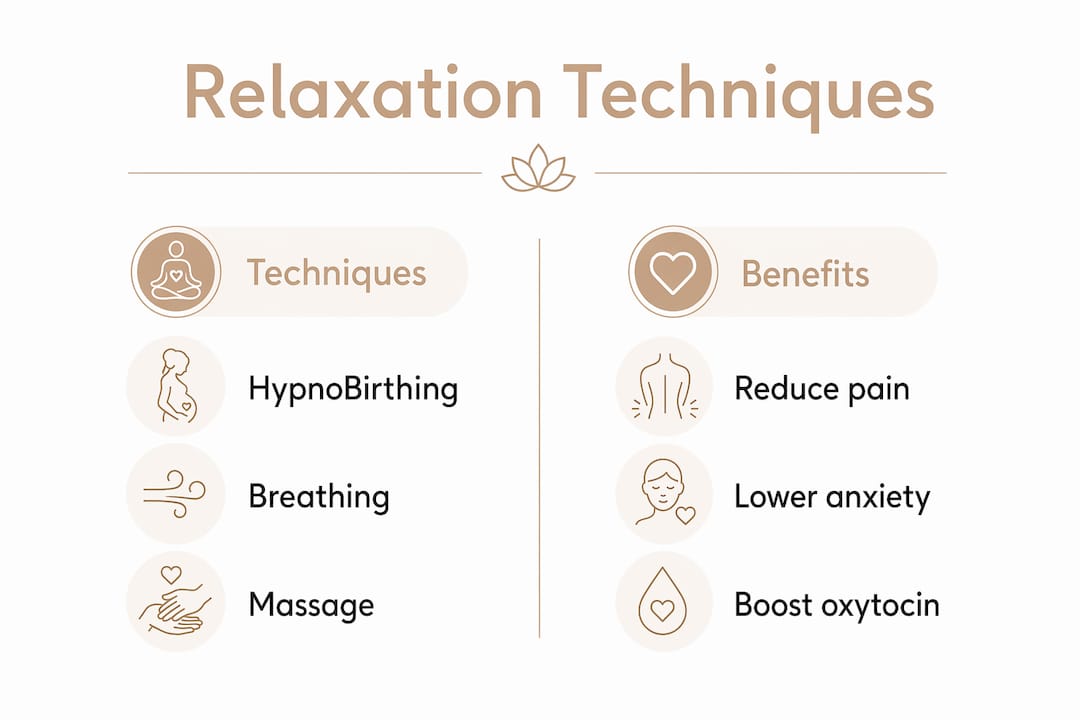
HypnoBirthing
HypnoBirthing uses guided self-hypnosis, visualisation, and deep relaxation to reframe how the mind interprets labour sensations. A 2026 study of 1,322 matched pairs found that HypnoBirthing significantly reduces the odds’ of epidural use, with an odds ratio of 0.50 in first-time mothers and 0.48 in those who had given birth before. It also reduced the likelihood of caesarean section. These are not marginal improvements. They represent a meaningful shift in birth outcomes for women who practise consistently.
Breathing exercises
Structured breathing, such as slow abdominal breathing or the 4-7-8 technique, gives you a physical anchor during contractions. Focusing on breath length prevents the shallow, panicked breathing that amplifies pain signals. Practising daily during pregnancy means the pattern becomes automatic when labour begins.
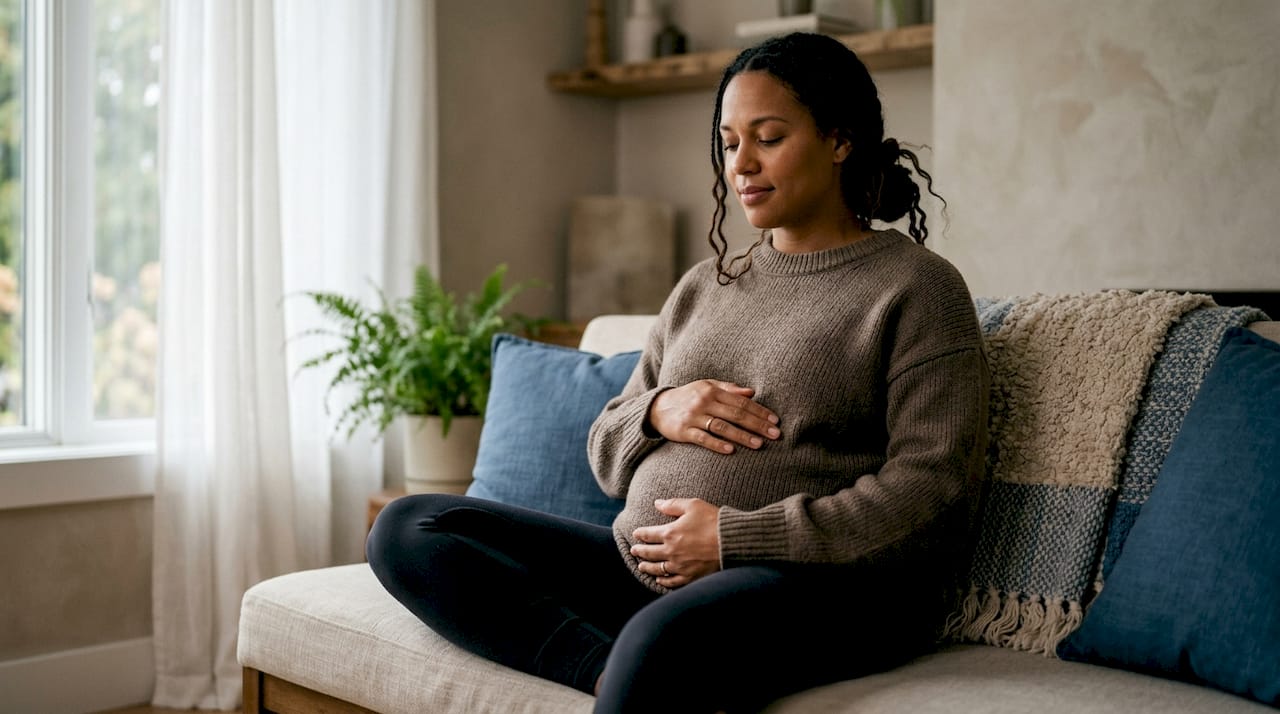
Massage and acupressure
Massage reduces cortisol, relaxes muscle tension, and promotes a sense of safety. Massage as a relaxation strategy is well documented for its calming effects on the nervous system. Acupressure targets specific points, such as the SP6 point on the inner ankle, to ease contraction pain and encourage cervical dilation.
Music therapy and guided imagery
Listening to familiar, calming music during labour reduces anxiety and shifts attention away from pain. Guided imagery, where you mentally rehearse a calm and positive birth, builds confidence and reduces fear. Both methods work best when practised regularly before labour begins.
| Technique | Primary benefit | Evidence level |
|---|---|---|
| HypnoBirthing | Fewer epidurals and caesareans | High (RCT, 1,322 pairs) |
| Breathing exercises | Reduced pain intensity | High (p = 0.001) |
| Massage and acupressure | Lower cortisol, muscle relaxation | High (meta-analysis, 29 RCTs) |
| Music therapy | Reduced anxiety and pain distraction | Moderate |
| Guided imagery | Increased confidence and calm | Moderate |
Pro Tip: Start practising your chosen technique by week 28 of pregnancy. The earlier you build the habit, the more automatic it becomes when contractions begin.
Are there limitations to relaxation for labour preparation?
Relaxation is powerful, but it is not a complete solution on its own. Relaxation techniques reduce physical pain but may not fully address perinatal anxiety, which has emotional and psychological roots that sometimes require professional support. Expecting relaxation alone to eliminate all fear or discomfort sets an unrealistic standard and can leave you feeling as though you have failed when labour is still challenging.
The effectiveness of any relaxation method also depends heavily on consistent practice. Childbirth self-efficacy, the belief in your own ability to cope with labour, increases measurably with regular, supported antenatal training. Without that repetition, techniques feel unfamiliar under pressure and are harder to access when you need them most.
Common misconceptions to address:
- Relaxation does not mean labour will be pain-free. It means pain becomes more manageable.
- Non-pharmacological methods complement medical care. They do not replace it.
- Relaxation works best as part of a broader birth plan that includes midwifery support.
- Perinatal anxiety may need additional psychological support alongside relaxation practice.
- One session is not enough. Consistent weekly practice builds the neural pathways that make techniques effective.
Non-pharmacological methods are endorsed by nursing and midwifery experts as part of multimodal care plans, not as standalone replacements for medical support. The most prepared mothers are those who combine relaxation with open communication with their midwife or obstetrician.
How to build relaxation into your daily routine before labour
Consistency is the single most important factor in making relaxation work. Building childbirth self-efficacy through regular antenatal practice produces measurable improvements in coping ability and confidence during labour. Treat relaxation practice the same way you treat antenatal appointments: non-negotiable and scheduled.
A practical daily routine might look like this:
- Morning breathing practice (5–10 minutes). Sit comfortably and practise slow abdominal breathing. Inhale for four counts, hold for two, exhale for six. This trains your nervous system to default to calm.
- Midday body scan (10 minutes). Lie on your left side and mentally scan from your feet upward, consciously releasing tension in each muscle group. This is particularly useful for releasing pelvic floor tension.
- Evening guided imagery or HypnoBirthing audio (20 minutes). Use a recorded programme to rehearse a calm, positive birth. Repetition builds familiarity, and familiarity reduces fear.
- Weekly massage or self-massage with a bump and body oil. Physical touch activates the parasympathetic nervous system and reinforces the mind-body connection you are building through breathing practice.
- Partner practice sessions (twice weekly). Partners can support relaxation by using vocal rhythm cues, speaking “three, two, one… relax” to guide slow, controlled breathing during practice contractions. This prepares both of you for the real thing.
Creating a calm home environment also matters during the latent phase. Dim lighting, familiar scents, and a warm bath can all signal safety to your nervous system and keep adrenaline low. Third-trimester self-care routines that incorporate these elements help you practise the environment you want to recreate during early labour.
Pro Tip: Record your own guided imagery script in your voice and listen to it nightly from week 32. Your own voice is uniquely calming to your nervous system.
Key takeaways
Relaxation reduces adrenaline, restores oxytocin, and builds the self-efficacy that makes labour more manageable, but only when practised consistently and integrated with professional maternity care.
| Point | Details |
|---|---|
| Adrenaline disrupts labour | Anxiety suppresses oxytocin and endorphins, slowing contractions and increasing pain. |
| HypnoBirthing cuts intervention rates | A 2026 study of 1,322 pairs found it halved the odds of epidural use. |
| Complementary therapies work | A meta-analysis of 29 RCTs confirmed a large effect size for labour pain reduction. |
| Consistency builds self-efficacy | Regular antenatal practice measurably improves coping confidence during labour. |
| Relaxation complements medical care | It reduces reliance on analgesics but works best alongside a full maternity care plan. |
Relaxation deserves more credit than it gets
Most birth preparation conversations focus on what will happen to you during labour. The hospital bag, the birth plan, the pain relief options. What gets far less attention is what you can actively train your body and mind to do before a single contraction begins.
I have seen women arrive at labour with weeks of breathing practice behind them, and the difference is visible. They are not fearless. Labour is still hard. But they have a tool they trust, and that trust changes everything. The moment a contraction peaks, they know what to do with their breath. That knowledge keeps adrenaline from flooding the system and shutting down the very hormones that make labour progress.
The scepticism I encounter most often is this: “It sounds too simple to actually work.” Controlled breathing feels almost embarrassingly low-tech compared to an epidural. But the physiology is not simple at all. You are actively managing your hormonal environment, and that has real, measurable consequences for how your labour unfolds.
My honest advice is to start earlier than you think you need to. Week 28 is not too soon. The women who feel most prepared are not the ones who read the most books. They are the ones who practised the most. Relaxation is a skill, not a mindset. Treat it like one.
— Nat
Natural products to support your relaxation practice
Preparing your body for labour is as much about daily rituals as it is about technique. Mumbubhub’s Mum to Be Essentials Bundle brings together natural, plant-based products designed to support calm and physical wellbeing throughout pregnancy. The Pregnancy Pamper Bundle pairs beautifully with an evening relaxation routine, offering gentle oils and balms that make massage and breathing practice feel genuinely restorative.
Every product in Mumbubhub’s pregnancy essentials range is formulated without harsh chemicals, so you can use them confidently throughout your third trimester. When relaxation becomes a daily ritual rather than an occasional effort, these products help make that ritual something you genuinely look forward to.
FAQ
Does relaxation actually reduce labour pain?
Yes. Breathing relaxation techniques significantly reduce pain intensity during the first stage of labour, with results confirmed at p-values of 0.001 and 0.002 in clinical trials.
What is HypnoBirthing and does it work?
HypnoBirthing is a structured programme using self-hypnosis, visualisation, and deep relaxation to prepare for birth. A 2026 study found it halved epidural use in first-time mothers compared to matched controls.
When should I start practising relaxation techniques?
Starting by week 28 of pregnancy gives you enough time to build the habit before labour begins. Childbirth self-efficacy increases with consistent antenatal practice, so earlier and more frequent sessions produce better outcomes.
Can relaxation replace pain relief medication during labour?
No. Relaxation reduces the need for analgesics and complements medical care, but it does not replace it. Integrated maternity care plans that combine relaxation with professional support produce the best outcomes.
How can my partner help with relaxation during labour?
Partners can use vocal rhythm cues, such as counting “three, two, one… relax,” to help maintain slow, controlled breathing during contractions. Practising this together before labour means the cue becomes a reliable anchor when it matters most.