

Pregnancy safe skincare: what's safe, what to skip
TL;DR:
- Most pregnancy-safe skincare options include fragrance-free moisturizers, mineral sunscreens, and low-strength actives like hyaluronic acid and niacinamide. Retinoids, high-dose hydroquinone, and strong chemical peels should be avoided during pregnancy and postponing certain treatments until postpartum is recommended. Using a simple routine with clinician-reviewed products and full ingredient transparency helps ensure safety for both mother and baby.
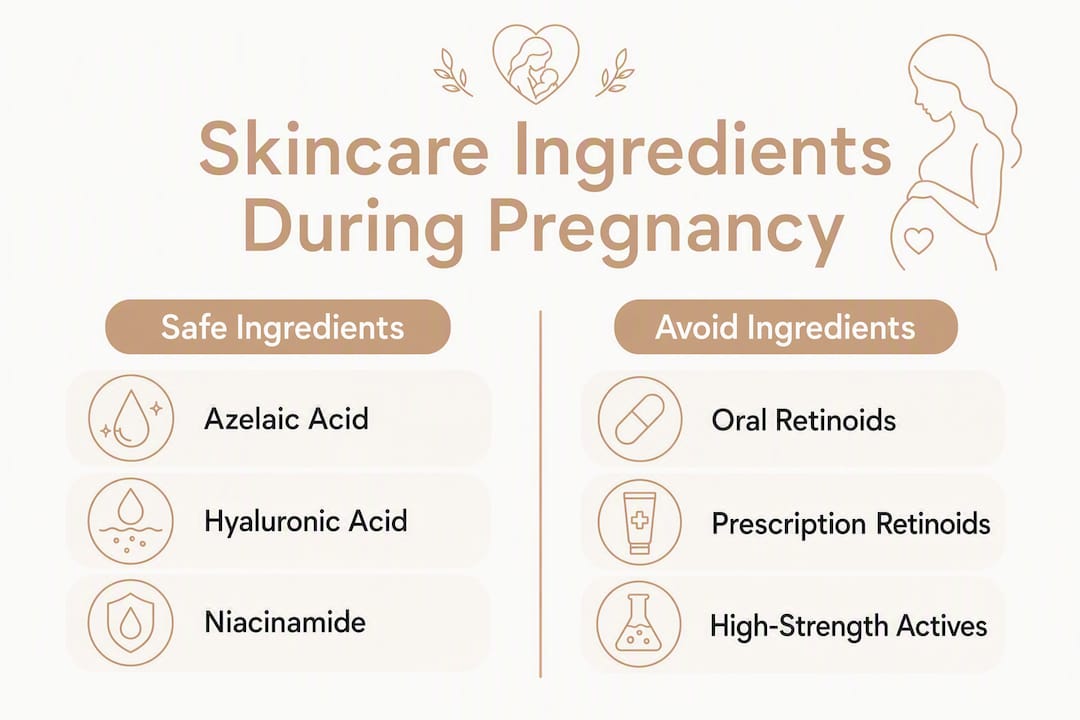
Most gentle, fragrance-free moisturisers, mineral sunscreens, and barrier-supporting actives are safe to use during pregnancy. The short list of what to avoid is more important than the long list of what you can use: stop oral retinoids immediately, pause prescription topical retinoids, avoid high-dose hydroquinone, and skip strong in-clinic chemical peels and oral isotretinoin. The single most important rule is this: bring your product packaging and full ingredient lists to your next prenatal appointment so your clinician can review them for your specific situation.
Safe categories at a glance:
- Gentle, fragrance-free cleansers
- Moisturisers with hyaluronic acid, shea butter, or ceramides
- Mineral sunscreens (zinc oxide, titanium dioxide) at SPF 30+
- Azelaic acid (for acne and pigmentation)
- Niacinamide (for redness, pores, and uneven tone)
- Low-strength glycolic acid (occasional use)
- Vitamin C (L-ascorbic acid)
Avoid during pregnancy:
- Oral retinoids (isotretinoin) — absolutely contraindicated
- Prescription topical retinoids (tretinoin, adapalene) — pause unless your clinician specifically clears them
- High-dose hydroquinone
- Strong in-clinic chemical peels and laser resurfacing
- Oral isotretinoin
Quick morning/night basics:
- Morning: gentle cleanser → vitamin C serum (optional) → moisturiser → mineral SPF 30+
- Night: gentle cleanser → azelaic acid or niacinamide → moisturiser
Table of Contents
- How does pregnancy commonly affect your skin?
- Which skincare ingredients should you avoid during pregnancy?
- Which ingredients are considered safe during pregnancy?
- What does a simple pregnancy-safe skincare routine look like?
- Which in-clinic treatments should you postpone during pregnancy?
- When can you restart retinoids and stronger actives after birth?
- How Mumbubhub approaches formulation and ingredient transparency
- Key takeaways
- The part most guides skip
- Mumbubhub’s pregnancy and postpartum bundles
- Useful sources and further reading
- FAQ
How does pregnancy commonly affect your skin?
Hormones drive almost every skin change in pregnancy, and they do not follow a predictable script. Some women experience the so-called “pregnancy glow” — increased sebum and blood flow giving skin a flushed, luminous look. Others find their skin becomes drier, more reactive, or prone to sudden breakouts for the first time in years.
First trimester changes tend to be the most unpredictable. Rising oestrogen and progesterone can trigger acne, heightened sensitivity, and the early appearance of melasma (sometimes called chloasma or the “mask of pregnancy”), particularly on the forehead, cheeks, and upper lip. Sun exposure accelerates melasma significantly, which is why mineral sunscreen use from early pregnancy matters.
The second trimester is often calmer for skin. Hormones stabilise somewhat, and many women find their skin settles into a more manageable state. The third trimester brings its own challenges: the skin stretches to accommodate a growing bump, which increases stretch-mark predisposition, and dryness or itching across the abdomen is common.
Common pregnancy-linked skin conditions include:
- Melasma (hormonal pigmentation, worsened by UV exposure)
- Pregnancy acne (hormonal sebum increase)
- Increased dryness or sensitivity, particularly on the face and abdomen
- Stretch marks (striae gravidarum), linked to skin stretching and reduced elasticity
- Pruritic urticarial papules and plaques of pregnancy (PUPPP) — an itchy rash requiring medical review
See a dermatologist or your midwife promptly if you develop a new, severe, or spreading rash during pregnancy. PUPPP and other pregnancy-specific dermatoses need proper diagnosis, not self-treatment.
Which skincare ingredients should you avoid during pregnancy?
The avoid list is shorter than most guides suggest, but the items on it matter. Oral retinoids are absolutely contraindicated in pregnancy because of well-documented links to serious birth defects affecting the face, heart, and brain. Topical retinoids sit in a more nuanced position.
Topical retinoids: the nuance worth knowing
When tretinoin is applied to intact skin as directed, only a small amount absorbs into the bloodstream. Prospective studies are limited and small, but case reports exist of birth defects in babies born to women who used topical tretinoin during pregnancy — and the defects resemble those seen with oral isotretinoin. Because the two are chemically related, guidance remains conservative: pause topical retinoids during pregnancy. The safest approach is to stop them at least one month before trying to conceive, and to restart only after delivery or weaning, with clinician input.
Numbered avoid list
- Oral isotretinoin — absolutely contraindicated; requires a negative pregnancy test before prescribing and strict contraception.
- Prescription topical retinoids (tretinoin, adapalene, tazarotene) — pause during pregnancy; case reports and chemical similarity to oral retinoids justify caution.
- High-dose hydroquinone — systemic absorption concerns; avoid prescription-strength formulations.
- Salicylic acid above 2% — low-strength leave-on products are generally considered low risk, but high-concentration peels should be avoided.
- Systemic drugs such as finasteride and tetracycline antibiotics — contraindicated in pregnancy.
- Strong in-clinic chemical peels (deep phenol or TCA peels) — postpone until postpartum.
Use sparingly and discuss with your clinician
- Benzoyl peroxide above 2.5% — low concentrations show minimal absorption, but higher concentrations warrant clinician review.
- Certain essential oils at high concentrations (clary sage, rosemary, camphor) — avoid in the first trimester particularly.
- Tranexamic acid in systemic form — topical use is lower risk but discuss with your GP.
Breastfeeding note
Oral retinoids are contraindicated while breastfeeding. Topical retinoids show low systemic absorption and are unlikely to appear in breast milk in significant amounts, but the guidance is to avoid applying them to the chest or nipple area so there is no ingestion risk for your baby.
Which ingredients are considered safe during pregnancy?
The good news is that the safe list is genuinely useful. Azelaic acid, hyaluronic acid, niacinamide, and low-strength glycolic acid are all frequently cited by dermatologists as appropriate choices that address the most common pregnancy skin concerns without meaningful systemic absorption risk.
| Ingredient | Why it’s considered safe | Main use cases | Typical concentration | Frequency | Pregnancy/breastfeeding caveat |
|---|---|---|---|---|---|
| Azelaic acid | Low systemic absorption; well-studied | Acne, melasma, redness | — | Once or twice daily | Generally safe; prescription strength — discuss with clinician |
| Hyaluronic acid | Topical humectant; not absorbed systemically | Hydration, plumping | 2% | Twice daily | Safe throughout |
| Niacinamide | Minimal absorption; anti-inflammatory | Acne, redness, pores, pigmentation | 2% | Twice daily | Safe throughout |
| Vitamin C (L-ascorbic acid) | Antioxidant; topical use, low systemic risk | Brightening, collagen support | — | Once daily (AM) | Safe; use stable formulations |
| Low-strength glycolic acid | AHA; low concentration = low penetration | Mild exfoliation, texture | 5% | 2–3 times per week | Avoid high-strength peels |
| Benzoyl peroxide (low dose) | Low absorption at 2.5–5% | Acne | 2.5–5% | Once daily | Use conservatively; avoid large surface areas |
| Zinc oxide / titanium dioxide | Mineral UV filters; very limited dermal absorption | Sun protection, melasma prevention | SPF 30–50+ | Every morning | Preferred over chemical filters in pregnancy |
| Ceramides, shea butter, squalane | Barrier-repair agents; no systemic concern | Dryness, sensitivity, stretch marks | Varies | Twice daily | Safe throughout |
Practical notes on combining actives:
- Azelaic acid and niacinamide work well together for melasma and acne.
- Vitamin C in the morning pairs well with mineral SPF for antioxidant and UV protection.
- Avoid layering multiple new actives at once — introduce one at a time and allow two weeks between additions.
- Fragrance-free formulations reduce the risk of sensitisation, which tends to increase during pregnancy.
Pro Tip: Patch test every new product during pregnancy, even ones you have used before. Apply a small amount to the inner forearm and wait 24–48 hours before using it on your face or body. Pregnancy can change your skin’s reactivity significantly.
For a deeper look at building a plant-based routine around these ingredients, the natural pregnancy skincare routine guide on the Mumbubhub blog walks through each step with product-specific suggestions.
What does a simple pregnancy-safe skincare routine look like?
Simplicity is the point. Dermatologists recommend keeping routines short during pregnancy to reduce the chance of accidental exposure to restricted ingredients and to minimise irritation on more reactive skin.
Morning routine
- Cleanse with a gentle, fragrance-free cleanser. Micellar water or a low-foam gel works well for most pregnancy skin types.
- Vitamin C serum (optional) — apply to dry skin before moisturiser for antioxidant protection and brightening. Particularly useful if melasma is a concern.
- Moisturise — choose a fragrance-free formula with hyaluronic acid, ceramides, or niacinamide to support the skin barrier.
- Mineral sunscreen — apply SPF 30 as a minimum; SPF 50 if you spend extended time outdoors or are managing melasma. Reapply every two hours in direct sun.
Evening routine
- Gentle cleanse to remove SPF, pollution, and any product residue.
- Targeted active — azelaic acid for acne or pigmentation, niacinamide for redness and pores, or low-strength glycolic acid (2–3 nights per week) for texture. Not all three at once.
- Moisturise — a slightly richer formula at night supports overnight barrier repair. Hyaluronic acid serums layered under a cream work well for dry or stretched skin.
Checklist for keeping your routine safe:
- Introduce only one new product at a time.
- Patch test for 24–48 hours before full application.
- Avoid products with fragrance, alcohol, or essential oils at high concentrations.
- During a flare-up (sensitivity, breakout, itching), strip back to cleanser, moisturiser, and SPF only.
- Bring your full product line-up to your next midwife or GP appointment for a quick review.
Pro Tip: If you are managing stretch marks, apply a fragrance-free body oil or balm to damp skin immediately after showering — this is when the skin barrier is most receptive to moisture. The stretch mark care guide from Mumbubhub covers which plant-based ingredients to look for.
Which in-clinic treatments should you postpone during pregnancy?
Most professional skin treatments are worth postponing until after delivery, not because every procedure carries proven risk, but because the evidence base for safety during pregnancy is thin and the consequences of getting it wrong are serious.
Procedures to postpone during pregnancy:
- Deep chemical peels (phenol, high-strength TCA) — systemic absorption risk; postpone until postpartum.
- Laser resurfacing and intense pulsed light (IPL) — limited safety data; avoid.
- Microneedling with active topical penetration (e.g. vitamin A serums applied during treatment) — avoid.
- Injectables including botulinum toxin and dermal fillers — no established safety data in pregnancy; postpone.
- Electrolysis and laser hair removal — limited data; most clinicians advise postponing.
Procedures that may be acceptable after clinician review:
- Superficial glycolic acid peels at low concentrations (under clinician supervision only).
- Certain light therapies for acne — discuss with your dermatologist and obstetrician together.
- Facials using pregnancy-safe topical products — generally low risk, but confirm ingredient lists with the therapist beforehand.
When it comes to in-clinic treatments during pregnancy, the guiding principle is simple: if the safety data is absent or limited, postpone. Most aesthetic procedures can wait six to twelve weeks postpartum. Your skin will recover; the risk of an adverse event during pregnancy is not worth the benefit of a cosmetic treatment.
Bring your treatment plan to your prenatal appointment. Clinicians can assess specific procedures and products more accurately when they have the full picture, including the products your aesthetician plans to use. Reviewing actual ingredient lists with your clinician is more reliable than relying on general online guidance.
When can you restart retinoids and stronger actives after birth?
The timeline depends primarily on whether you are breastfeeding, and on the strength of the product you want to reintroduce.
Realistic milestones
- 4–6 weeks postpartum (not breastfeeding): A dermatologist may clear low-strength topical retinoids at this point, starting with retinol rather than prescription tretinoin and building gradually.
- 3 months postpartum (not breastfeeding): Most stronger actives, including prescription topical retinoids, can be reintroduced with dermatologist guidance. Skin is often still hormonally unsettled, so starting slowly remains sensible.
- While breastfeeding: Topical retinoids show low systemic absorption and are unlikely to appear in breast milk in significant amounts. However, the standard recommendation is to avoid applying them to the chest or nipple area, minimise the surface area treated, and discuss timing with your dermatologist. Many clinicians advise waiting until after weaning for prescription-strength retinoids.
- After weaning: Once breastfeeding has stopped, you can restart a full active routine under dermatologist guidance. Oral retinoids require specialist management, a confirmed negative pregnancy test, and contraception.
Postpartum skin often behaves differently from pre-pregnancy skin. Hormonal shifts after delivery can trigger melasma flares, acne, or increased dryness, so reintroducing actives gradually and with sun protection in place makes practical sense. The postpartum skin preparation guide from Mumbubhub covers what to expect in those early weeks.
Questions to ask your GP or dermatologist when planning to restart actives:
- Is my skin barrier recovered enough to tolerate retinoids?
- Am I still breastfeeding, and does that change the recommendation?
- Should I start with over-the-counter retinol or go straight to prescription tretinoin?
- Do I need contraception in place before starting oral retinoids?
- Are there any bloodwork checks needed before restarting prescription actives?
How Mumbubhub approaches formulation and ingredient transparency
The guidance in this article draws on peer-reviewed dermatology literature, the MotherToBaby fact sheets from the NCBI Bookshelf, InfantRisk Centre resources on retinoids and nursing, and conservative interpretation of ambiguous data — particularly around topical retinoids and hydroquinone, where evidence is limited and the stakes are high.
A consistent finding across the evidence base is that unbranded or third-party marketplace products may lack verified ingredient concentrations and safety testing. Choosing products with transparent, published ingredient lists and clear concentration information reduces that uncertainty meaningfully.
Mumbubhub formulates its pregnancy and postpartum range with plant-based, chemical-free ingredients and publishes full ingredient lists on every product page. The brand’s approach reflects the same principle that runs through this article: when evidence is limited or ambiguous, err on the side of caution and give customers the information they need to make their own informed choices.
What to look for in a pregnancy-safe brand:
- Full INCI ingredient list published on the product page, not just a highlights list.
- Clear disclosure of concentrations for actives (azelaic acid, glycolic acid, niacinamide).
- Fragrance-free or clearly labelled fragrance sources.
- No vague “pregnancy-safe” marketing claims without ingredient-level transparency.
- Batch testing information available on request.
The natural ingredients in gifting guide on the Mumbubhub blog explains the brand’s formulation philosophy in more detail, including why plant-based sourcing matters for sensitive pregnancy skin. For sustainable beauty choices more broadly, clean-beauty selection criteria are worth understanding before you buy.
This article is general information, not medical advice. Always confirm product safety with your midwife, GP, or dermatologist for your individual circumstances.
Key takeaways
Safe skincare during pregnancy centres on three things: stopping retinoids and high-risk actives, keeping your routine simple with barrier-supporting ingredients, and reviewing your full product list with your clinician.
| Point | Details |
|---|---|
| Stop retinoids immediately | Pause oral and prescription topical retinoids as soon as you know you are pregnant; restart only with clinician guidance after delivery. |
| Mineral SPF every morning | Zinc oxide or titanium dioxide at SPF 30+ prevents melasma and protects sensitive pregnancy skin from UV damage. |
| Safe actives to use | Azelaic acid, hyaluronic acid, niacinamide, vitamin C, and low-strength glycolic acid are all considered appropriate for pregnancy. |
| Patch test every new product | Apply to the inner forearm for 24–48 hours before full use; pregnancy changes skin reactivity unpredictably. |
| Mumbubhub for plant-based options | Mumbubhub’s pregnancy range uses transparent, plant-based formulations designed for safe use during pregnancy and postpartum recovery. |
The part most guides skip
The conversation around pregnancy skincare tends to focus heavily on the avoid list, which is useful, but it can leave you feeling like your only safe option is water and a flannel. That framing misses something important: the ingredients that are genuinely safe in pregnancy are also genuinely effective. Azelaic acid handles both acne and pigmentation. Niacinamide calms redness and supports the barrier. Mineral SPF prevents melasma from worsening. You are not making do with second-best options.
The other thing worth saying plainly: the “pregnancy-safe” label on a product means nothing in UK law. It is a marketing phrase, not a regulated claim. What actually matters is the ingredient list, the concentrations, and whether a clinician has reviewed your specific products. A beautifully branded “natural” product from a third-party marketplace with no published INCI list is not automatically safer than a well-formulated product from a brand that publishes every ingredient and its concentration. Transparency is the signal worth trusting.
The simplest version of good pregnancy skincare is also the most defensible: a gentle cleanser, a fragrance-free moisturiser, a mineral SPF, and one or two well-chosen actives from the safe list. Everything else can wait.
Mumbubhub’s pregnancy and postpartum bundles
If you want to skip the ingredient-label scrutiny and go straight to products formulated with pregnancy safety in mind, Mumbubhub’s range is built around exactly that. Every product uses plant-based, chemical-free ingredients with full INCI lists published on the product page.
Here are the bundles worth knowing about, depending on where you are in your pregnancy or postpartum journey:
- Pregnancy Pamper Bundle — curated for expectant mothers who want a complete, safe self-care set during pregnancy.
- Mum to Be Essentials Bundle — a practical gift set for expectant mothers covering the key pregnancy care essentials.
- Prep and Recover Bundle — designed for the final weeks of pregnancy and early recovery after birth.
- Postpartum Essentials Bundle — focused on postpartum healing and gentle recovery care for new mothers.
- Rest & Restore Bundle — a relaxation-focused set for new mothers who need genuine rest and skin recovery support.
- Me Time Self Care Bundle — for moments of calm during pregnancy or the early postpartum period.
- Soothing Duo — a compact two-product option for managing skin sensitivity and irritation.
Browse the full pregnancy essentials collection to find the right fit for your stage of pregnancy or postpartum recovery. If you have a question about a specific ingredient in any product, the Mumbubhub customer service team can help. And as always, bring the product packaging to your next prenatal appointment for your clinician to review.
Useful sources and further reading
These are the primary sources used to inform this article. All are freely accessible and worth bookmarking for your own reference.
- MotherToBaby: Topical Tretinoin fact sheet (NCBI Bookshelf) — detailed, evidence-based summary of topical tretinoin use in pregnancy and breastfeeding; one of the most reliable freely available resources on this specific question.
- Safety of skin care products during pregnancy (PMC) — peer-reviewed review covering a broad range of cosmetic ingredients and their safety profiles in pregnancy; the source for much of the ingredient-level guidance in this article.
- American Academy of Dermatology: pregnancy skin care — board-certified dermatologist guidance on routine simplification and mineral sunscreen use.
- InfantRisk Centre: retinoid skincare and nursing — specific guidance on topical retinoid use while breastfeeding, including chest/nipple application advice.
- UVA Health: healthy skincare routines during pregnancy — practical clinician advice including the recommendation to bring product packaging to prenatal appointments.
- Mothersafe / Royal Hospital for Women guidance (SES LHD) — Australian clinical guidance on skin and hair products in pregnancy; particularly useful on unbranded and third-party marketplace products.
- NHS: health things you should know in pregnancy — NHS overview of substances and products to be cautious about during pregnancy; the primary UK public health reference.
- Healthline: pregnancy-safe skin care — accessible summary of safe and unsafe ingredients with dermatologist input.
Bring printed ingredient lists from your current products to your next midwife, GP, or dermatology appointment. A clinician reviewing your actual formulations will always give you more reliable guidance than any general list.
FAQ
What skincare ingredients should you avoid when pregnant?
The key ingredients to avoid are oral retinoids (isotretinoin), prescription topical retinoids (tretinoin, adapalene), high-dose hydroquinone, high-concentration salicylic acid peels, and strong in-clinic chemical peels. The NHS advises checking with your midwife or GP if you are unsure about any product.
Which skincare brands are considered safe for pregnancy in the UK?
There is no legally regulated “pregnancy-safe” certification in the UK, so the most reliable approach is to choose brands that publish full INCI ingredient lists with concentrations and avoid retinoids, high-dose hydroquinone, and synthetic fragrance. Mumbubhub’s plant-based pregnancy range is formulated with this transparency in mind.
Is retinol safe to use while breastfeeding?
Topical retinoids show low systemic absorption and are unlikely to appear in breast milk in significant amounts, but the standard advice is to avoid applying them to the chest or nipple area. Many dermatologists recommend waiting until after weaning before restarting prescription-strength retinoids; discuss the timing with your GP or dermatologist.
What is the safest sunscreen to use during pregnancy?
Mineral sunscreens containing zinc oxide or titanium dioxide are the preferred choice in pregnancy. They have very limited dermal absorption, have been used safely to help prevent melasma, and are less likely to cause irritation than chemical UV filters. SPF 30 is the minimum; SPF 50 is worth using if you spend extended time outdoors.
When can you restart retinoids after giving birth?
If you are not breastfeeding, a dermatologist may clear low-strength topical retinoids from around 4–6 weeks postpartum, with prescription-strength options typically discussed from three months onwards. If you are breastfeeding, most clinicians recommend waiting until after weaning before reintroducing prescription retinoids.